Advertisements
Advertisements
प्रश्न
Concentration of mineral nutrient elements is higher inside the root hairs than in the surrounding soil. How do roots take them in from the soil?
Advertisements
उत्तर
If the concentration of mineral nutrient elements is higher inside the root-hairs than in the
surrounding soil, then roots take them in from the soil by 'active transport'. In active transport, the mineral ions are forcibly carried from the surrounding soil i.e. the region of their lower concentration into the roots i.e. the region of their higher concentration through the cell membrane by expenditure of energy. This energy is supplied by the cell in the form of ATP.
संबंधित प्रश्न
The phenomenon of loss of water through a cut stem or injured part of plant is called ___________.
What are root hair? Mention the function performed by the root hair.
Mention whether the following statement is true (T) or false (F) and give explanation in support of your answer.
Dry seeds when submerged in water swell up due to endosmosis.
The diagram below represents a layer of epidermal cells showing a fully grown root hair. Study the diagram and answer the questions that follow:

Draw a diagram of the above root hair cell as it would appear when a concentrated solution of fertilizers is added near it.
The figure given below is a diagrammatic representation of a part of the cross-section of the root in the root hair zone. Study the same and then answer the questions that follow :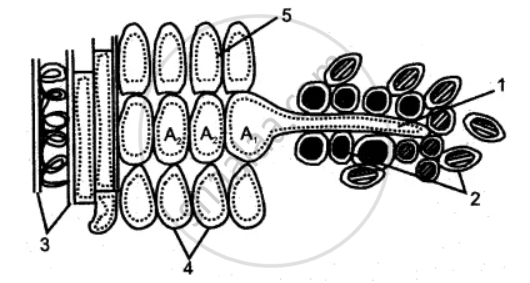
(i) Name the parts indicated by guidelines ‘1’ to ‘5’
(ii) Is the root hair cell unicellular or multi-cellular?
(iii) Draw a labeled diagram of the root hair cell as it would appear if some fertilizer is added to the soil close to it.
(iv) Name the process responsible for the entry of water molecules from the soil into A1 and then A2.
(v) What pressure is responsible for the movement of water in the direction indicated by arrows?
(vi) How is this pressure set up?
Multiple Choice Question:
The most widely accepted theory for ascent of sap is ______.
Define: Root hair
____________ regions are present in a typical root.
Which plant does tissue transport water and minerals from the roots to the leaf?
Water in the root enters due to ______.
