Advertisements
Advertisements
प्रश्न
Advertisements
उत्तर
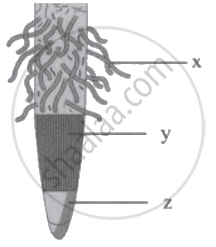
Root hairs absorb maximum water because in this region, the xylem is not fully mature but the epidermis and endodermis are still permeable to water.
APPEARS IN
संबंधित प्रश्न
Study the diagram given below and answer the questions that follow:
- Name the process being studied in the above experiment.
- Explain the process mentioned in (a) above
- Why is oil placed over water?
- What do we observe with regard to the level of water when this set-up is placed in (1) bright sunlight, (2) humid conditions and (3) windy days?
- Mention any three adaptations found in plants to foster the process mentioned in (a) above
The diagram given below represents a plant cell after being placed in a strong sugar solution. Guidelines 1 to 5 indicate the following:
1. Strong sugar solution
2. Cell wall
3. Protoplasm
4. Large vacuole
5. Nucleus
Study the diagram and answer the questions that follow:
(i) What is the state of the cell shown in the diagram?
(ii) Name the structure which acts as a selectively permeable membrane.
(iii) If the cell had been placed in distilled water instead of strong sugar solution which feature would not have been present?
(iv) If the cell in the diagram possessed chloroplasts where would these be present?
(v) Name any one feature of this plant cell which is not present in animal cells.

Mention whether the following statement is true (T) or false (F) and give an explanation in support of your answer.
Guttation in plants occurs maximum at midday.
Study the experimental setup in the figure and then answer the question that follow.

What is meant by 'semipermeable membrane'?
Grapes shrink when immersed in a very strong sugar solution.” Explain.
Name the following:
Water is absorbed from the soil by which part.
Column ‘II’ is a list of items related to ideas in Column ‘I’. Match the term in Column ‘II’ with a suitable idea given in Column ‘I’.
| Column I | Column II |
| (i) Diffusion | (a) The exit or flow of water from the cell to the outer environment. |
| (ii) Xylem | (b) The shrinkage of protoplasm when the cell is kept in a hypertonic solution. |
| (iii) Root pressure | (c) The tissue through which water and mineral salts move upward in a plant. |
| (iv) Isotonic solution | (d) Two solutions which have equal osmotic pressure. |
| (v) Exosmosis | (e) The process by which the molecules of perfume spread in the room when the bottle is open. |
| (vi) Osmosis | (f) The process by which roots absorb water from the soil. |
| (vii) Plasmolysis | (g) The pressure by which water rises up to some feet in a lofty tree. |
| (viii) Hypotonic solution | (h) The concentration of the solution when lower than that of the cell sap. |
Root hairs are ______
Trace the pathway followed by water molecules from the time it enters a plant root to the time it escapes into the atmosphere from a leaf.
What is peculiarity of epiphytic plants like orchids?