Advertisements
Advertisements
प्रश्न
Advertisements
उत्तर
APPEARS IN
संबंधित प्रश्न
The figure given below is a diagrammatic representation of a part of the cross section of the root in the root hair zone. Study the same and then answer the questions that follow

(i) Name the parts indicated by the guidelines 1 to 4.
(ii) Which is the process that enables the passage of water from the soil into the root hair?
(iii) Name the pressure that is responsible for the movement of water in the direction indicated by the arrows. Define it.
(iv) Due to an excess of this pressure sometimes drops of water are found along the leaf margins of some plants especially in the early mornings. What is the phenomenon called?
(v) Draw a well labelled diagram of the root hair cell as it would appear if an excess of fertiliser is added to the soil close to it.
Choose the correct answer:
Swelling of wooden doors during rains is caused by ___________
How is root hair structurally adapted for absorption of water from the soil?
The alongside diagram A shows a root hair growing through the soil particles. Diagram B is the root hair of an aquatic plant.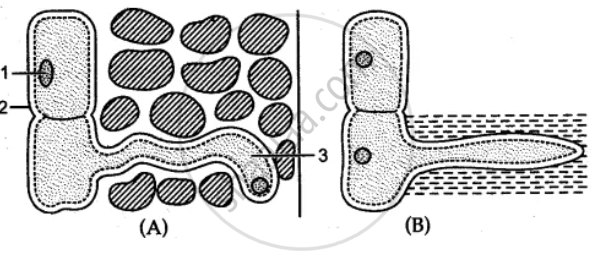
(i) Name the parts 1,2,3.
(ii) Name two substances which enter the root hair. What are their uses?
(iii) By what process do these substances enter the root hair?
(iv) Account for the different shapes of root hairs in the two diagrams.
Draw a diagram of the root hair cell as it would appear when a concentrated solution of fertilizers is added near it.
Name the following:
Water is absorbed from the soil by which part.
Multiple Choice Question:
Process of endosmosis stops:
Draw a neat and labelled diagram of the Root tip showing the root hair zone.
Part of the root that absorbs water from the soil is ______.
Look at Figure. Draw another figure of the same set-up as would be observed after a few hours.

