Advertisements
Online Mock Tests
Chapters
1: Cell Division
2: Structure of Chromosomes
3: Principles of Genetics
Unit-2 Plant Physiology
▶ 4: Absorption by Roots
5: Transpiration
6: Photosynthesis
7: Chemical Coordination in Plants
8: Circulatory System
Unit-3 Human Anatomy and Physiology
9: Excretory System
10: Nervous System
11: Endocrine System
12: Reproductive System
13: Human Population
14: The Evolution of Man
15: Theories of Evolution
16: Types of Pollution
17: Sources of Pollution and Major Pollutants
18: Effects of Pollution
19: Abatement of Pollution
20: Greenhouse Effects, Global Warming, Ozone Layer Depletion and Acid Rain
![Frank solutions for Biology Part 2 [English] Class 10 ICSE chapter 4 - Absorption by Roots - Shaalaa.com](/images/biology-part-2-english-class-10-icse_6:4cd9978ddb1c4f42b0b0e9ec6f09c057.jpg "Frank solutions for Biology Part 2 [English] Class 10 ICSE chapter 4 - Absorption by Roots")
Advertisements
Solutions for Chapter 4: Absorption by Roots
Below listed, you can find solutions for Chapter 4 of CISCE Frank for Biology Part 2 [English] Class 10 ICSE.
Frank solutions for Biology Part 2 [English] Class 10 ICSE 4 Absorption by Roots Exercises [Pages 52 - 57]
Choose the correct alternative from the choices given below each statement.
Osmosis involves diffusion of ______.
suspended particles from lower concentration to higher concentration.
suspended particles from higher concentration to lower concentration.
water from the more concentrated solution to the less concentrated solution.
water from the less concentrated solution to the more concentrated solution.
Choose the correct answer:
An example of a selective permeable membrane is __________
cell wall
mitochondrial membrane
chloroplast membrane
plasmalemma
Choose the correct answer:
Plasmolysis will occur when the cell is placed in a __________
hypotonic solution
isotonic solution
hypertonic solution
acidic solution
Choose the correct answer:
Grapes when placed in a strong sugar solution shrink because of __________
diffusion
plasmolysis
exosmosis
endosmosis
Choose the correct answer:
Cell turgidity is caused by _______________
endosmosis
exosmosis
plasmolysis
diffusion
Choose the correct answer:
If a marine plant is transferred to fresh water, it bursts due to ___________
exosmosis
endosmosis
plasmolysis
diffusion
Choose the correct answer:
Which one is semi-permeable?
Plasmalemma
Cell wall
Endoplasmic reticulum
Golgi body
Choose the correct answer:
Swelling of wooden doors during rains is caused by ___________
endosmosis
imbibition
capillarity
osmosis
Choose the correct answer:
Meaning of ascent of sap is ____________
absorption of water from soil.
alteration of water against gravitational force.
reaching of water upwards against gravitational force.
origin of cohesive force in water.
Process of ascent of sap in plants occurs by ______.
cortex
xylem
phloem
cambium
Choose the correct answer:
Absorption of water from soil takes place by __________
root cap region
root hairs
elongation zone
maturation zone
Choose the correct answer:
In ascent of sap water reaches upwards ____________
In the form of a solid column.
in the form of a fragile column.
to some places in the form of solid and to some places in liquid form.
none of the above.
Choose the correct answer:
The water is translocated upwards from the roots through _____________
xylem
phloem
pith
endodermis
Choose the correct answer:
Wilting of plants occurs when ____________
phloem is blocked.
xylem is blocked.
a few old roots are removed.
both xylem and phloem are blocked.
When placed in tap water, marine fish die because of ______.
endosmosis
exosmosis
diffusion
plasmolysis
A plant cell may burst when :
Turgor pressure equalises wall pressure.
Turgor pressure exceeds wall pressure.
Wall pressure exceeds turgor pressure.
None of the above
Deplasmolysis occurs when a plasmolysed cell is placed in ______.
Concentrated salt solution
Tap water
Concentrated sugar solution
Hypertonic salt solution
Osmosis takes place when there is ______.
A freely permeable membrane
A cell wall
A selectively permeable membrane
An impermeable membrane
Following questions consist of two statements - Assertion (A) and Reason (R). Answer these questions by selecting the appropriate option given below:
Assertion (A): Absorption of soil water by root is mostly an active process.
Reason (R): Most of the water is absorbed by the plants through osmotic mode that occurs due to concentration gradient and hence does not require metabolic energy.
Both A and R are true and R is the correct explanation of A.
Both A and R are true but R is not the correct explanation of A.
A is true but R is false.
A is false but R is true.
Assertion (A): Plants absorb water mostly by roots.
Reason (R): Root cap region participates actively in water absorption.
Both A and R are true and R is the correct explanation of A.
Both A and R are true but R is not the correct explanation of A.
A is true but R is false.
A is false but R is true.
Assertion (A): Mineral salt absorption is an active process.
Reason (R): Metabolic energy is not used in active absorption.
Both A and R are true and R is the correct explanation of A.
Both A and R are true but R is not the correct explanation of A.
A is true but R is false.
A is false but R is true.
Assertion (A): Glucose, Na+ and amino acids are absorbed actively.
Reason (R): Na+, glucose and amino acids move against the concentration gradient and hence require energy.
Both A and R are true and R is the correct explanation of A.
Both A and R are true but R is not the correct explanation of A.
A is true but R is false.
A is false but R is true.
Assertion (A): Water and minerals are absorbed from roots and are transported upwards to various parts of the plant.
Reason (R): The process by which a substance absorbed from the roots of the plant is moved to the upper part of the plant is known as active transport.
Both A and R are true and R is the correct explanation of A.
Both A and R are true but R is not the correct explanation of A.
A is true but R is false.
A is false but R is true.
Assertion (A): Plant roots absorb water from soil colloids.
Reason (R): Hygroscopic water is held by soil colloids.
Both A and R are true and R is the correct explanation of A.
Both A and R are true but R is not the correct explanation of A.
A is true but R is false.
A is false but R is true.
Assertion (A): The driving force for passive absorption is non-metabolic in origin.
Reason (R): The driving force for active absorption is energy derived from metabolic processes.
Both A and R are true and R is the correct explanation of A.
Both A and R are true but R is not the correct explanation of A.
A is true but R is false.
A is false but R is true.
Assertion (A): Absorption of soil water by root is mostly an active process.
Reason (R): Most of the water is absorbed by the plants through osmotic mode that occurs due to concentration gradient and hence does not require metabolic energy.
Both A and R are true and R is the correct explanation of A.
Both A and R are true but R is not the correct explanation of A.
A is true but R is false.
A is false but R is true.
Name the following:
The pressure with which the molecules of a substance diffuse.
Name the following:
Two solutions having same concentrations.
Name the following:
The force developing in shoot responsible for most of the absorption of water.
Name the following:
The uptake of mineral ions against concentration gradient.
Name the following:
Tissue concerned with upward conduction of water.
Name the following:
Condition of cell in which the cell contents are shrunken.
Name the following:
The inward movement of solvent molecules through the plasma membrane of the cell.
Name the following:
The process by which raisins swell up when placed in a beaker of water.
Name the following:
Movement of molecules from a region of high concentration to a region of low concentration.
Name the following:
The process by which roots absorb water from the soil.
Name the following:
Unicellular outgrowths from the epidermis of roots.
Arrange and rewrite the terms in the group in the correct order to be in a logical sequence beginning with the term that is underlined:
Xylem, Soil water, Cortical cells, Root hair.
Arrange and rewrite the terms in group in correct order to be in a logical sequence, beginning with the term that is underlined:
Water vapour, Soil water, Leaves, Ascent of Sap.
Fill in the blanks.
______ is the process by which molecules distribute themselves evenly within the space they occupу.
______ is the phenomenon of contraction of the cytoplasm from the cell wall.
Loss of water as droplets through leaves of an intact plant is termed ______.
Distinguish between the following:
Filtration and diffusion
Distinguish between the following:
Turgor pressure and osmotic pressure
Distinguish between the following:
Hypotonic and Hypertonic solutions
Distinguish between Diffusion and Osmosis.
Distinguish between the following:
Flaccid condition and turgid condition
Distinguish between the following:
Plasmolysis and deplasmolysis
Differentiate between the following
Active transport and Passive transport.
Name the following:
The inward movement of solvent molecules through the plasma membrane of the cell.
Name the following:
Tissue concerned with upward conduction of water.
Name the following:
Condition of cell in which the cell contents are shrunken.
Explain why:
Raisins swell up in water.
Explain why:
We gargle with saline solution in case of throat infection.
Explain why:
Bacteria and fungi do not grow in pickles, jams, jellies and squashes.
Explain why:
The leaves of wilted lettuce, if kept in cold water, become crisp.
Define the following:
Osmosis
Define the following:
Diffusion
Define the following:
Turgor pressure
Define the following:
Hypertonic solution
Define the term:
Plasmolysis
How is root hair adapted for the absorption of water from the soil?
What part is played by the following in the uptake of water into the root hair?
The cell wall
What part is played by The cytoplasm in the uptake of water into the root hair?
What would happen to the root hair of a potted plant if the soil was watered with an extremely concentrated solution of sodium chloride?
Correct the following statement by changing the underlined word.
The cell sap of root hair is hypotonic.
Correct the following statement by changing the underlined word.
Xylem transports starch from the leaves to all parts of the plant body.
Give the appropriate biological or technical term for the following.
Movement of molecules of a substance from their higher concentration to lower concentration when they are in direct contact.
Differentiate between the following on the basis of what is indicated in the bracket.
Hypotonic solution and Hypertonic solution (condition of a plant cell when placed in them).
What is Active transport?
What is “semi permeable membrane”?
Name the semi permeable membrane present in a plant cell.
Mention two adaptations in roots for absorption of water from the soil.
The apparatus arranged alongside signifies an important process.
(i) Name the process.
(ii) Where does this process occur in plants?
(iii) What solution is placed inside the dialysis tubing?
(iv) What happens to the level of the solution in the capillary tube?

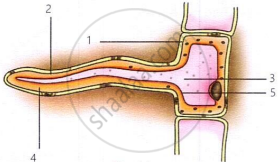
- The figure alongside is a diagram of a root hair. On the diagram, name the parts labelled 1 to 5.
- What role is played in the uptake of water into the root hair by the parts numbered 1, 2 and 3?
- What would happen if living cells of a plant were planted first in a strong solution of cane sugar and then in water?
The diagram given below represents a plant cell after being placed in a strong sugar solution. Guidelines 1 to 5 indicate the following:
1. Strong sugar solution
2. Cell wall
3. Protoplasm
4. Large vacuole
5. Nucleus
Study the diagram and answer the questions that follow:
(i) What is the state of the cell shown in the diagram?
(ii) Name the structure which acts as a selectively permeable membrane.
(iii) If the cell had been placed in distilled water instead of strong sugar solution which feature would not have been present?
(iv) If the cell in the diagram possessed chloroplasts where would these be present?
(v) Name any one feature of this plant cell which is not present in animal cells.

The figure shows a diagrammatic representation of the movement of certain substances inside the stem of a certain plant. Write five sentences on whatever you can explain about the processes or the arrangement of structures indicated in the diagram.
Note: - Each sentence must include one or more of the following four words, and each word can be used several times. Xylem, phloem, roots, leaves.

The diagram given below represents the results of an experiment conducted on two freshly taken leafy shoots of a herbaceous plant. The lower ends of the shoots dip in ordinary water.
(i) What is the aim of the experiment?
(ii) Some parts of the stem in both the shoots have been removed. Name the conducting tissue in shoot (a) and in shoot (b) that has been removed.
(iii) What are the results of this experiment?

Three plants (a), (b) and (c) were placed in beakers containing coloured water. The water in each beaker was covered with a layer of oil. The leaves were removed from plant (b), while plant (c) was exposed to strong light.
(i) In which plant, (a), (b) or (c) would the water move up the fastest?
(ii) In which plant (a), (b) or (c), would the water move up slowly?
(iii) Why was the water covered with a layer of oil?
(iv) What is being investigated by this experiment?

The figure given is a diagrammatic representation of a part of the cross section of the root in the root-hair zone. Study the same and then answer the questions that follow:
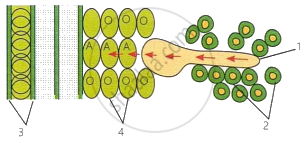
- Name the parts indicated by the guidelines 1 to 4.
- Which is the process that enables the passage of water from the soil into the root hair?
- Name the pressure that is responsible for the movement of water in the direction indicated by the arrows. Define it.
- Due to an excess of this pressure, sometimes drops of water are found along the leaf margins of some plants especially in the early mornings.What is the phenomenon called?
- Draw a well-labelled diagram of the root-hair cell as it would appear if excess of fertiliser is added to the soil close to it.
A candidate in order to study the process of osmosis has taken 3 potato cubes and put them in 3 different beakers containing 3 different solutions. After 24 hours, in the first beaker the potato cube increased in size, in the second beaker the potato cube decreased in size and in the third beaker there was no change in the size of the potato cube. The following diagram shows the result of the same experiment:

(i) Give the technical terms of the solutions used in beakers, 1, 2 and 3.
(ii) In beaker 3, the size of the potato cube remains the same. Explain the reason in brief.
(iii) Write the specific feature of the cell sap of root hairs which helps in absorption of water.
(iv) What is osmosis?
(v) How does a cell wall and a cell membrane differ in their permeability?
Solutions for 4: Absorption by Roots
Frank solutions for Biology Part 2 [English] Class 10 ICSE chapter 4 - Absorption by Roots
Shaalaa.com has the CISCE Mathematics Biology Part 2 [English] Class 10 ICSE CISCE solutions in a manner that help students grasp basic concepts better and faster. The detailed, step-by-step solutions will help you understand the concepts better and clarify any confusion. Frank solutions for Mathematics Biology Part 2 [English] Class 10 ICSE CISCE 4 (Absorption by Roots) include all questions with answers and detailed explanations. This will clear students' doubts about questions and improve their application skills while preparing for board exams.
Further, we at Shaalaa.com provide such solutions so students can prepare for written exams. Frank textbook solutions can be a core help for self-study and provide excellent self-help guidance for students.
Concepts covered in Biology Part 2 [English] Class 10 ICSE chapter 4 Absorption by Roots are Plant Physiology, Characteristics of Roots for Absorbing Water, Imbibition, Diffusion, Osmotic Pressure, Concept of Absorption by the Roots, Need of Water and Minerals for Plants, Turgidity and Flaccidity (Plasmolysis), Root Pressure, Forces Contributing to Ascent of Sap, Active Transport, Absorption and Conduction of Water and Minerals, Passive Transport, Uses of Turgidity to Plants, Comparison of Diffusion, Osmosis and Active Transport, Importance of Root Hairs and Upward Transport, Experiments on Absorption and Conduction of Water in the Plants, Plant Physiology, Characteristics of Roots for Absorbing Water, Imbibition, Diffusion, Osmotic Pressure, Concept of Absorption by the Roots, Need of Water and Minerals for Plants, Turgidity and Flaccidity (Plasmolysis), Root Pressure, Forces Contributing to Ascent of Sap, Active Transport, Absorption and Conduction of Water and Minerals, Passive Transport, Uses of Turgidity to Plants, Comparison of Diffusion, Osmosis and Active Transport, Importance of Root Hairs and Upward Transport, Experiments on Absorption and Conduction of Water in the Plants.
Using Frank Biology Part 2 [English] Class 10 ICSE solutions Absorption by Roots exercise by students is an easy way to prepare for the exams, as they involve solutions arranged chapter-wise and also page-wise. The questions involved in Frank Solutions are essential questions that can be asked in the final exam. Maximum CISCE Biology Part 2 [English] Class 10 ICSE students prefer Frank Textbook Solutions to score more in exams.
Get the free view of Chapter 4, Absorption by Roots Biology Part 2 [English] Class 10 ICSE additional questions for Mathematics Biology Part 2 [English] Class 10 ICSE CISCE, and you can use Shaalaa.com to keep it handy for your exam preparation.
