Advertisements
Online Mock Tests
Chapters
▶ 1: Cell Division
2: Structure of Chromosomes
3: Principles of Genetics
Unit-2 Plant Physiology
4: Absorption by Roots
5: Transpiration
6: Photosynthesis
7: Chemical Coordination in Plants
8: Circulatory System
Unit-3 Human Anatomy and Physiology
9: Excretory System
10: Nervous System
11: Endocrine System
12: Reproductive System
13: Human Population
14: The Evolution of Man
15: Theories of Evolution
16: Types of Pollution
17: Sources of Pollution and Major Pollutants
18: Effects of Pollution
19: Abatement of Pollution
20: Greenhouse Effects, Global Warming, Ozone Layer Depletion and Acid Rain
![Frank solutions for Biology Part 2 [English] Class 10 ICSE chapter 1 - Cell Division - Shaalaa.com](/images/biology-part-2-english-class-10-icse_6:4cd9978ddb1c4f42b0b0e9ec6f09c057.jpg "Frank solutions for Biology Part 2 [English] Class 10 ICSE chapter 1 - Cell Division")
Advertisements
Solutions for Chapter 1: Cell Division
Below listed, you can find solutions for Chapter 1 of CISCE Frank for Biology Part 2 [English] Class 10 ICSE.
Frank solutions for Biology Part 2 [English] Class 10 ICSE 1 Cell Division Exercises [Pages 10 - 14]
Choose the correct alternative from the choices given below each statement.
Which stage of cell division takes the maximum time?
Prophase
Metaphase
Anaphase
Telophase
Choose the correct answer:
Somatic cells divide by ___________
mitosis
meiosis
both of these
none of these
Choose the correct answer:
Cytokinesis involves
Constriction in animal cell
plate formation in plant cell
both of these
none of these
Choose the correct answer:
In meiosis, chromosome number is reduced by
1/2
1/4
3/4
1/3
Choose the correct answer :
Mitosis results in
gamete
growth and repair
both (a) & (b)
none of these
Choose the correct answer:
Centromere is related to ________
movement of chromosomes
DNA replication
all of these
spindle formation
Choose the correct answer:
Crossing over is a feature of _______________
meiosis
mitosis
amitosis
none of these
Choose the correct answer:
DNA replication takes place in _____________
mitosis
amitosis
meiosis
both (a) and (c)
Choose the correct answer:
In an interphase cell chromosome are as _____________
microtubules
chromatin
flagella
chromatid
Choose the correct answer:
During mitosis which of the following disintegrate _________
nucleolus
nuclear membrane
both (a) and (b)
none of these
Chromosomes get aligned at the center of the cell during ______.
anaphase
metaphase
prophase
telophase
Chromosome number is halved in ______.
meiosis I
meiosis II
mitosis
amitosis
Choose the correct answer:
If after karyokinesis, cytokinesis does not occur, then result would be ___________
two nuclei, two cells
one nucleus, two
two cells, no nuclei
one cell, two nuclei
Choose the correct answer:
Gametes are formed by ________________
meiosis
mitosis
amitosis
none of these
Choose the correct answer:
Minimum coiling in chromosome is at ______________
prophase
metaphase
anaphase
telophase
During mitosis, chromosome is most coiled at ______.
telophase
anaphase
metaphase
prophase
Choose the correct answer:
Nuclear membrane reappears in _________________
metaphase
prophase
telophase
anaphase
The cell component visible only during the cell division is ______.
mitochondria
chloroplast
chromosome
chromatin
Synthesis phase in the cell cycle is called so, because of the synthesis of more ______.
RNA
RNA and Proteins
DNA
Glucose
During the synthesis phase of the cell cycle, more of ______.
RNA is synthesised.
RNA and proteins are synthesised.
DNA is synthesised.
Glucose is synthesised.
Assertion-Reason Type Questions Following questions consist of two statements - Assertion (A) and Reason (R). Answer these questions by selecting the appropriate option given below:
Assertion (A): Interphase is resting stage.
Reason (R): The interphase cell is metabolically inactive.
Both A and R are true and R is the correct explanation of A.
Both A and R are true but R is not the correct explanation of A.
A is true but R is false.
A is false but R is true.
Assertion (A): DNA synthesis occurs in G1 and G2 periods of cell cycle.
Reason (R): During G1 and G2 phase, the DNA content become double.
Both A and R are true and R is the correct explanation of A.
Both A and R are true but R is not the correct explanation of A.
A is true but R is false.
A is false but R is true.
Assertion (A): Due to inactivation of the cell cycle, some cells undergo G0 phase.
Reason (R): Go phase occurs due to non-availability of mitogen and energy rich compounds.
Both A and R are true and R is the correct explanation of A.
Both A and R are true but R is not the correct explanation of A.
A is true but R is false.
A is false but R is true.
Assertion (A): G1 phase is the interval between mitosis and initiation of DNA replication.
Reason (R): The cell is metabolically inactive during G1 phase.
Both A and R are true and R is the correct explanation of A.
Both A and R are true but R is not the correct explanation of A.
A is true but R is false.
A is false but R is true.
Assertion (A): Cell growth results in disturbing the ratio between the nucleus and cytoplasm.
Reason (R): Mitosis helps the cell to restore the nucleocytoplasmic ratio.
Both A and R are true and R is the correct explanation of A.
Both A and R are true but R is not the correct explanation of A.
A is true but R is false.
A is false but R is true.
Assertion (A): Cell growth is a continuous process in terms of cytoplasmic increase.
Reason (R): DNA synthesis occurs only during two specific stages in the cell cycle.
Both A and R are true and R is the correct explanation of A.
Both A and R are true but R is not the correct explanation of A.
A is true but R is false.
A is false but R is true.
Assertion (A): Every chromosome during metaphase has two chromatids.
Reason (R): Synthesis of DNA takes places in the S-phase of interphase.
Both A and R are true and R is the correct explanation of A.
Both A and R are true but R is not the correct explanation of A.
A is true but R is false.
A is false but R is true.
Assertion (A): Mitosis maintains the genetic similarity of somatic cells.
Reason (R): Chromosomes do not undergo crossing over.
Both A and R are true and R is the correct explanation of A.
Both A and R are true but R is not the correct explanation of A.
A is true but R is false.
A is false but R is true.
Assertion (A): Karyokinesis occurs in M-phase.
Reason (R): Cell division stops in M-phase.
Both A and R are true and R is the correct explanation of A.
Both A and R are true but R is not the correct explanation of A.
A is true but R is false.
A is false but R is true.
Assertion (A): Prophase is the first stage of mitosis which follows S and G1 phases of interphase.
Reason (R): Prophase is marked by the initiation of clusters of chromosomes.
Both A and R are true and R is the correct explanation of A.
Both A and R are true but R is not the correct explanation of A.
A is true but R is false.
A is false but R is true.
Assertion (A): During anaphase, centromere of each chromosomes splits and chromatids separate.
Reason (R): Chromatids move to opposite poles.
Both A and R are true and R is the correct explanation of A.
Both A and R are true but R is not the correct explanation of A.
A is true but R is false.
A is false but R is true.
Assertion (A): Mitosis is often called indirect division.
Reason (R): Mitosis divides a parent cell into two daughter cells.
Both A and R are true and R is the correct explanation of A.
Both A and R are true but R is not the correct explanation of A.
A is true but R is false.
A is false but R is true.
Name the following.
The exchange of chromatid parts between the maternal and the paternal chromatids of a pair of homologous chromosomes during meiosis.
Name the following.
The division of cytoplasm of a parent cell into daughter cells.
Name the following.
Type of cell division which occurs in the cell of the reproductive organs.
Name the following.
The collective term used for all the nuclear changes that occur in the mitotic cell division.
Name the following.
Type of cell division taking place in somatic cell.
Name the following.
The organelle that forms the aster during cell division.
Name the following.
The non-dividing phase of the cell cycle where more DNA is synthesised.
Rewrite the terms in logical sequence.
Karyokinesis, S-phase, Cytokinesis, G1-phase, G2-phase (Cell cycle)
Rewrite the terms in logical sequence.
Metaphase, Telophase, Prophase, Anaphase, Cytokinesis. (Stages of cell division)
Fill in the blank:
______ takes place in body cells resulting in growth and development.
Fill in the blank:
The energy for cell division is stored as ______.
Fill in the blank:
Both ______ and heterotypic divisions occur in meiosis.
Fill in the blank:
Meiotic division is also called ______ division.
Mitosis occurs in our ______ cells.
State whether the following statement is true or false. If false, write the correct form of the statement by changing the word/words.
The resting stage in mitosis is called interphase.
State whether the following statement is true or false. If false, write the correct form of the statement by changing the word/words.
Mitosis is the type of cell division occurring in the cells of injured parts of the body.
State whether the following statement is true or false. If false, write the correct form of the statement by changing the word/words.
Centromere is the organelle of the cell that initiate cell division.
State whether the following statement is true or false. If false, write the correct form of the statement by changing the word/words.
During the formation of reproductive cells, mitotic cell division occurs.
State whether the following statement is true or false. If false, write the correct form of the statement by changing the word/words.
Meiosis is called reduction division.
State whether the following statement is true or false. If false, write the correct form of the statement by changing the word/words.
Karyokinesis refers to division of cytoplasm.
Given below are group of terms. In each group the first pair indicates the relationship between the terms. Rewrite and complete the second pair on a similar basis.
Cytoplasm : Cytokinesis :: Nucleus : ______
Somatic cell : Mitosis :: Germ cell : ______
Meiosis : Reduction division :: Mitosis : ______
Define the following:
Karyokinesis
Define the following:
Cytokinesis
Define the following:
Chiasmata
Give the specific function of the following structure found in the cells.
Centrosome
Give the specific function of the following structure found in the cells.
Chromosome
Give the specific function of the following structure found in the cells.
Spindle fibres
Give the specific function of the following structure found in the cells.
Nucleus
How many daughter cells would you expect if 4 cells undergo:
Mitosis
How many daughter cells would you expect if 4 cells undergo:
Meiosis
How many daughter cells would you expect if 4 cells undergo:
Amitosis
Why is cell division necessary?
What do you understand by cell cycle?
Describe anaphase in mitosis.
Choose the odd one out and name the category to which it belongs.
Centrosome, Cell wall, Cell membrane, Large Vacuole.
The diagram given alongside represents a stage of mitosis.
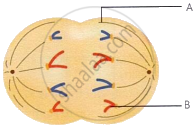
- Identify the stage of cell division.
- Name the parts labelled A and B.
- What is the unique feature observed in this stage?
- How many daughter cells are formed from this type of cell division?
The fig given alongside shows a certain stage in a cell division in a cell with four chromosomes.
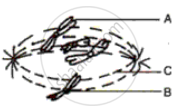
(i) Name the parts of the chromosome labeled A and B.
(ii) Name the structure C. what is its function?
(iii) Name the type of division . Give a reason.
(iv) Name the stage of division.
(v) Name the stages before and after the stage shown in diagram.
Given below is a diagram representing a stage during mitotic cell division. Study it carefully and answer the questions that follow:
(i) Is it a plant cell or an animal cell? Give a reason to support your answer.
(ii) Identify the stage shown.
(iii) Name the stage that follows the one shown here. How is that stage identified?
(iv) How will you differentiate between mitosis and meiosis on the basis of the chromosome number in the daughter cells?
The diagram given alongside shows a stage during mitotic division in an animal cell:
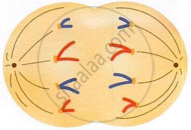
- Identify the stage. Give a reason to support your answer.
- Draw a neat labelled diagram of the cell as it would appear in the next stage. Name the stage.
- In what two ways is mitotic division in an animal cell different from the mitotic division in a plant cell?
- Name the type of cell division that occurs during:
- Growth of a shoot
- Formation of pollen grains
Study the diagram given alongside which represents a stage during the mitotic cell division and answer the questions that follow:
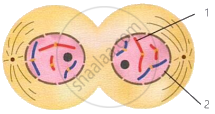
- Identify the stage giving suitable reasons.
- Name the parts numbered 1 and 2.
- What is the technical term for the division of nucleus?
- Mention the stage that comes before the stage shown in the diagram. Draw a neat labelled diagram of the stage mentioned.
- Which is the cell division that results in half the number of chromosomes in daughter cells?
Draw a well labelled diagram to show the metaphase stage of mitosis in an animal cell having four chromosomes.
Draw a well-labelled diagram to show the anaphase stage of mitosis in plant cells having four chromosomes.
The diagram given alongside represents a stage during cell division. Study the same and answer the questions that follow:
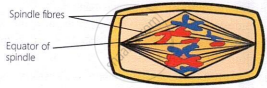
- Identify whether it is a plant cell or an animal cell. Give a reason to support your answer.
- Name the stage depicted in the diagram. What is the unique feature observed in this stage?
- Name the type of cell division that occurs during:
- Replacement of old leaves by new ones.
- Formation of gametes.
- What is the stage that comes before the stage shown in the diagram?
- Draw a neat, labelled diagram of the stage mentioned in (d) above keeping the chromosome number constant.
Given alongside is a diagram representing a stage during the mitotic cell division. Study the diagram and answer the following questions:
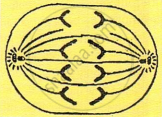
- Identify the stage by giving a suitable reason.
- Is it a plant or an animal cell? Give a reason to support your answer.
- Draw a neat, labelled diagram of the stage which follows the one shown in the diagram.
- How many chromosomes will each daughter cell have after the completion of the above division?
- Name the four nitrogenous bases.
The diagram given below represents a stage in mitosis.

- Identify the stage given above.
- Give one reason to support your answer in (a).
- Mention the number of chromosomes given in the diagram.
Solutions for 1: Cell Division
Frank solutions for Biology Part 2 [English] Class 10 ICSE chapter 1 - Cell Division
Shaalaa.com has the CISCE Mathematics Biology Part 2 [English] Class 10 ICSE CISCE solutions in a manner that help students grasp basic concepts better and faster. The detailed, step-by-step solutions will help you understand the concepts better and clarify any confusion. Frank solutions for Mathematics Biology Part 2 [English] Class 10 ICSE CISCE 1 (Cell Division) include all questions with answers and detailed explanations. This will clear students' doubts about questions and improve their application skills while preparing for board exams.
Further, we at Shaalaa.com provide such solutions so students can prepare for written exams. Frank textbook solutions can be a core help for self-study and provide excellent self-help guidance for students.
Concepts covered in Biology Part 2 [English] Class 10 ICSE chapter 1 Cell Division are Mitosis > Karyokinesis (Division of Nucleus), Need for New Cells, Cell Cycle - "Divide, Grow and Redivide", Meiosis: Reduction Division, Chromatin, Deoxyribonucleic Acid (DNA), Histone Proteins, Stages of Meiosis: Meiosis I, Stages of Meiosis: Meiosis II, Cell Division: an Essential Life Process, Mitosis > Karyokinesis (Division of Nucleus), Mitosis > Cytokinesis (Division of Cytoplasm), Genes and Genetic, Significance of Meiosis, Significance of Mitosis, Mitosis Vs Meiosis, Comparison of Mitosis in Plant and Animal Cells, Interphase, Mitochondria and Chloroplasts in Cell Division, Organisms Show Variety in Cell Number, Shape and Size, Cell: Structural and Functional Unit of Life, Plant Cell Vs Animal Cell, Structure of the Cell > Cell Wall: “Supporter and Protector”, Structure of the Cell > Nucleus: “Brain” of the Cell, Cell Organelles, Microscopic Examination of Onion Peel, Ribosomes - "The sites of protein synthesis", Lysosome - “Suicidal Bag”, Centrosome and Centrioles, Plastids, Non-living Substances Or Cell Inclusion, Endoplasmic Reticulum (ER), Mitochondria - “Power House of the Cell”, Golgi Apparatus - "The delivery system of the cell", Structure of the Cell > Plasma Membrane / Cell Membrane, Structure of the Cell > Cytoplasm: “Area of Movement”, Mitosis > Karyokinesis (Division of Nucleus), Need for New Cells, Cell Cycle - "Divide, Grow and Redivide", Meiosis: Reduction Division, Chromatin, Deoxyribonucleic Acid (DNA), Histone Proteins, Stages of Meiosis: Meiosis I, Stages of Meiosis: Meiosis II, Cell Division: an Essential Life Process, Mitosis > Karyokinesis (Division of Nucleus), Mitosis > Cytokinesis (Division of Cytoplasm), Genes and Genetic, Significance of Meiosis, Significance of Mitosis, Mitosis Vs Meiosis, Comparison of Mitosis in Plant and Animal Cells, Interphase, Mitochondria and Chloroplasts in Cell Division.
Using Frank Biology Part 2 [English] Class 10 ICSE solutions Cell Division exercise by students is an easy way to prepare for the exams, as they involve solutions arranged chapter-wise and also page-wise. The questions involved in Frank Solutions are essential questions that can be asked in the final exam. Maximum CISCE Biology Part 2 [English] Class 10 ICSE students prefer Frank Textbook Solutions to score more in exams.
Get the free view of Chapter 1, Cell Division Biology Part 2 [English] Class 10 ICSE additional questions for Mathematics Biology Part 2 [English] Class 10 ICSE CISCE, and you can use Shaalaa.com to keep it handy for your exam preparation.
