Advertisements
Advertisements
Question
Fill in the blank:
______ takes place in body cells resulting in growth and development.
Advertisements
Solution
Mitosis takes place in body cells resulting in growth and development.
APPEARS IN
RELATED QUESTIONS
The diagram given below represents a certain stage of mitosis:
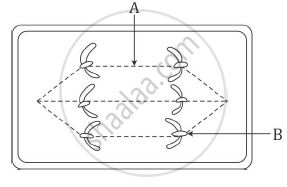
- Identify the stage of cell division.
- Name the parts labelled A and B.
- What is the unique feature observed in this stage?
- How many daughter cells are formed from this type of cell division?
Genetic recombination occurs in ______ phase of prophase of meiosis-I.
With the help of suitable diagrams, explain the five stages of prophase-I of meiosis.
Fill in the blank:
______ is the indirect cell division.
Choose the correct answer:
Nuclear membrane reappears in ____________
Identify the stages of mitosis given below and label the figures.
The diagram below represents a certain stage of a cell.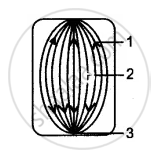
(i) Is it an animal cell or a plant cell ? Give one reason in support of your answer.
(ii) Label the parts numbered 1 – 3.
(iii) Which stage (phase) of mitosis is represented in this diagram
Draw a labeled schematic representation of mitosis cell division.
Name the Following
The stage when chromosomes arrange at the equator.
Give Technical Terms
The stage at which spindle fibres begin to be formed.
Complete the following sentence with appropriate word :
Colchicine arrests cell division at __________.
Multiple Choice Question:
The nuclear membrane and nucleolus become indistinguishable during
Write the functional activity of the following structure:
Colchicine
Explain the following figure.

In which stage of mitosis the chromosomes align in an equatorial plate? How?
Match List - I with List - II.
| List - I | List - II |
| A. Centromere | I. Mitochondrion |
| B. Cilium | II. Cell division |
| C. Cristae | III. Сell movement |
| D. Cell membrane | IV. Phospholipid Bilayer |
Choose the correct answer from the options given below:
