Advertisements
Online Mock Tests
Chapters
1: Cell Division
2: Structure of Chromosomes
▶ 3: Principles of Genetics
Unit-2 Plant Physiology
4: Absorption by Roots
5: Transpiration
6: Photosynthesis
7: Chemical Coordination in Plants
8: Circulatory System
Unit-3 Human Anatomy and Physiology
9: Excretory System
10: Nervous System
11: Endocrine System
12: Reproductive System
13: Human Population
14: The Evolution of Man
15: Theories of Evolution
16: Types of Pollution
17: Sources of Pollution and Major Pollutants
18: Effects of Pollution
19: Abatement of Pollution
20: Greenhouse Effects, Global Warming, Ozone Layer Depletion and Acid Rain
![Frank solutions for Biology Part 2 [English] Class 10 ICSE chapter 3 - Principles of Genetics - Shaalaa.com](/images/biology-part-2-english-class-10-icse_6:4cd9978ddb1c4f42b0b0e9ec6f09c057.jpg "Frank solutions for Biology Part 2 [English] Class 10 ICSE chapter 3 - Principles of Genetics")
Advertisements
Solutions for Chapter 3: Principles of Genetics
Below listed, you can find solutions for Chapter 3 of CISCE Frank for Biology Part 2 [English] Class 10 ICSE.
Frank solutions for Biology Part 2 [English] Class 10 ICSE 3 Principles of Genetics Exercises [Pages 36 - 42]
Choose the correct answer:
Mendel conducted his hybridization experiments on _______
potato
garden pea
cow pea
pigeon pea
Choose the correct answer:
If a homozygous tall plant is crossed with a heterozygous tall plant, the proportion of tall progeny would be ____________
25%
50%
75%
100%
Choose the correct answer:
Mendel used ______ pairs of a characters for his experiments.
5
6
7
4
Choose the correct answer:
Father of genetics ________
Darwin
Pasteur
Lamarck
Mendel
Choose the correct answer:
The allele which masks the effect of its complement is _______
dominant
recessive
monohybrid
dihybrid
Choose the correct answer:
If any of Mendel's characters were linked; one would have been unable to derive.
Law of Dominance
Law of Segregation
Law of Independent Assortment
None of these
Choose the correct answer:
The contrasting characters used by Mendel are called _____
alleles
heteromorphs
genes
none of the above
Choose the correct answer:
If a pea plant with round seeds is selfed and the offspring are in the ratio 3:1, then the plant is _________
homozygous
heterozygous
both
none of these
Choose the correct answer:
A cross where two pairs of alleles are considered is a ____________
dihybrid cross
monohybrid cross
polyhybrid cross
test cross
Choose the correct answer :
Human sex chromosomes are __________
X and O
Y and O
X and Y
none of these
Choose the correct answer:
Haemophilia is due to recessive gene on __________
X chromosome
Y chromosome
autosome
none of these
Choose the correct answer:
Males have more chances of suffering from sex-linked disease because of ___________
one Y chromosome
one X chromosome
autosomes
none of these
Choose the correct answer:
A single recessive trait, able to express must be on _________
Y chromosome
X chromosomes in male
X chromosome in female
autosome
Choose the correct answer:
A carrier haemophilic woman marries a haemophilic man. What are the chances for her progeny to be haemophilic?
25%
75%
50%
100%
Choose the correct answer:
A colour blind woman marries a normal man, in the progeny _________
one son and one daughter are normal
sons are colour blind and daughters are normal
sons are colour blind and daughters are carriers
none of these
Choose the correct answer:
A man can transfer his sex-linked gene to his ______________
son
daughter
both
none of these
The recessive gene is one that expresses itself in ______.
heterozygous condition
homozygous condition
F2 generation
Y-linked inheritance
The sex chromosome in a human ovum is ______.
X chromosome
Y chromosome
Both X and Y chromosomes
Either X or Y chromosome
A zygote which has Y chromosome inherited from the father will develop into a ______.
Will depend on the chromosome inherited from the mother
Girl
Either boy or a girl
Boy
Four friends P, Q, R and S were discussing the examples of genetic disorders. The examples they quoted were as follows:
P. Colour blindness and Malaria
Q. Albinism and Cholera
R. Haemophilia and Colour blindness
S. Haemophilia and Albinism
Who gave the correct examples?
P and Q
R and S
P and R
Q and S
Assertion-Reason Type Questions Following questions consist of two statements - Assertion (A) and Reason (R). Answer these questions by selecting the appropriate option given below:
Assertion (A): Genes present in every cell of an organism control the traits of the organisms.
Reason (R): Gene is specific segment of DNA occupying specific position on a chromosome.
Both A and R are true and R is the correct explanation of A.
Both A and R are true but R is not the correct explanation of A.
A is true but R is false
A is false but R is true.
Assertion (A): In grasshoppers, females are heterogametic and males are homogametic.
Reason (R): In grasshoppers, male has only one sex chromosome (XO) whereas the female has sex chromosomes (XX).
Both A and R are true and R is the correct explanation of A.
Both A and R are true but R is not the correct explanation of A.
A is true but R is false.
A is false but R is true.
Assertion (A): Round green seeds in pea can be represented by RRyy of Rryy.
Reason (R): Round yellow seeds and green wrinkled seeds are parental combinations whereas round green and wrinkled yellow are recombinants.
Both A and R are true and R is the correct explanation of A.
Both A and R are true but R is not the correct explanation of A.
A is true but R is false.
A is false but R is true.
Assertion (A): If a mother has two dominant alleles for black hair and father has two recessive alleles for blonde hair then their child will inherit one dominant allele from mother and one recessive allele from father and will have black hair.
Reason (R): Progeny inherits one genes for each trait from its parents but the trait shown by progeny depends on inherited alleles.
Both A and R are true and R is the correct explanation of A.
Both A and R are true but R is not the correct explanation of A.
A is true but R is false.
A is false but R is true.
Name the following.
Father of genetics.
Name the following.
The branch of Science that deals with heredity.
Name the following:
A genetic disorder in which the blood does not clot.
Name the following:
The basic units of heredity.
Name the following.
The sex chromosome of male.
Name the following.
The number of pairs of autosomes in human being.
Name the following.
The chemical substance constituting genes.
Name the following.
An alternation in the genetic material that can be inherited.
State whether the following is true or false. If false, rewrite the correct form of the statement by changing the word/words.
The plant used by Mendel was sweet pea.
State whether the following is true or false. If false, rewrite the correct form of the statement by changing the word/words.
The chemical present in RNA is gene.
State whether the following is true or false. If false, rewrite the correct form of the statement by changing the word/words.
Mendel used 5 pair of characteristics for his experiment.
State whether the following is true or false. If false, rewrite the correct form of the statement by changing the word/words.
A cross where the pairs of alleles are crossed is a dihybrid cross.
Differentiate between genotype and phenotype.
Differentiate between the following:
Dominant and Recessive genes
Differentiate between the following:
Homogametic and Heterogametic
Differentiate between the following:
Monohybrid and Polyhybrid cross
Define the following:
Genotype
Define the following:
Phenotype
Define the following:
Homozygous
Define the following:
Heterozygous
Define the following:
Allele
Define the following:
Dominant
Define the following:
Recessive
Complete the sentence by inserting the correct word:
______ is the scientific name of garden pea, which Mendel used for his experiments.
Explain the following.
Why colour blindness is more common in men than in women.
Why did Mendel select pea plants for his experiment?
Explain the following.
How the sex of a child depends upon its father.
Predict the genotype and phenotype of the following cross in pea.
TT × Tt
(Capital letters show dominance)
- Give the ratio of phenotypes of the cross.
- Mention whether the cross is a monohybrid or dihybrid.
Predict the genotype and phenotype of the following cross in pea.
tt × TT
(Capital letters show dominance)
- Give the ratio of phenotypes of the cross.
- Mention whether the cross is a monohybrid or dihybrid.
Predict the genotype and phenotype of the following cross in pea.
TTrr × ttRR
(Capital letters show dominance)
- Give the ratio of phenotypes of the cross.
- Mention whether the cross is a monohybrid or dihybrid.
Predict the genotype and phenotype of the following cross in pea.
TtRr × TtRr
(Capital letters show dominance)
- Give the ratio of phenotypes of the cross.
- Mention whether the cross is a monohybrid or dihybrid.
Define the following:
Sex chromosomes
Define the following:
Sex-linked characters
State Mendel’s laws.
Name two genetic disorders commonly seen in human body.
A woman has normal vision but her father was colour blind. If she is married to a colour blind person, report on the occurrence of the disease in the progeny.
State Mendel's law of dominance.
State Mendel’s Law of Segregation.
Suppose you are given two pairs of contrasting characters: Seed colour → yellow and green , seed coat → round and wrinkled.
Fill in the following table to show that F2 generation according to the principle of independant assortment as given by Mendel.
| Selfing among hybrids of F1 | RY | Ry | rY | ry |
| RY | ||||
| Ry | ||||
| rY | ||||
| Ry | ||||
| F2 generation |
Answer the following briefly:
Explain with the help of a chart what will be the colour of a child's hair if father has got dominant gene for black hair and mother has recessive gene for brown hair?
Explain the following terms:
Laws of Inheritance
Explain the following term:
Sex-linked characters
A family consists of two parents and their five children and the pedigree chart below shows the inheritance of the trait colour blindness .
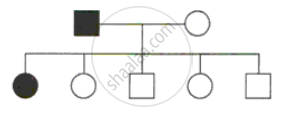
(i) Who is colour blind in parents - Father or Mother?
(ii) How many daughters and sons have beeen born in the family?
(iii) What does the child 1 indicate about this trait?
(iv) Complete the depiction of all probabilities of the trait among the children 2-5 in the chart.
(v) On which chromosome is the gene of this trait located?
(vi) Name one other trait in humans which follows the similar mode of inheritance.
A homozygous plant having round (R) and yellow (Y) seeds is crossed with homozygous plant having wrinkled (r) and green (y) seeds:
- Give the scientific name of the plant on which Mendel conducted his hybridization experiments.
- Give the genotype of the F1 generation.
- Give the dihybrid phenotypic ratio and the phenotype of the offspring of the F2 generation when two plants of the F1 generation are crossed.
- Name and state the law which explains the dihybrid ratio.
- Give the possible combinations of gametes that can be obtained from F1 hybrid.
Given below is a schematic diagram showing Mendel’s Experiment on sweet pea plants having axial flowers with round seeds (AARR) and Terminal flowers with wrinkled seeds (aarr). Study the same and answer the questions that follow :

(i) Give the phenotype of F1 progeny.
(ii) Give the phenotypes of F2 progeny produced upon by the self-pollination of F1 progeny.
(iii) Give the phenotypic ratio of F2 progeny.
(iv) Name and explain the law induced by Mendel on the basis of the above observation.
In a homozygous plant round seeds (R) are dominant over wrinkled seeds (r):
- Draw a Punnett square to show the gametes and offsprings when both the plants have heterozygous round seeds (Rr).
- Mention the phenotype and genotype ratios of the offsprings in F2 generation.
- Name the sex chromosomes in human males and females.
- Briefly explain the term ‘Mutation’.
- What is the number of chromosomes in the gametes of human beings?
A homozygous tall plant (T) bearing red-coloured (R) flowers is crossed with a homozygous dwarf (t) plant bearing white (r) flowers:
- Give the genotype and phenotype of the plants of F1 generation.
- Mention the possible combinations of the gametes that can be obtained from the F1 hybrid plant.
- State Mendel’s law of independent assortment.
- Mention the phenotypes of the offsprings obtained in F2 generation.
- What is the phenotypic ratio obtained in F2 generation?
In a homozygous pea plant, axial flowers (A) are dominant over terminal flowers (a).
- What is the phenotype and genotype of the F1 generation if a plant bearing pure axial flowers is crossed with a plant bearing pure terminal flowers?
- Draw a Punnett square board to show the gametes and offsprings when both the parent plants are heterozygous for axial flowers.
- What is the phenotypic ratio and genotypic ratio of the above cross shown in (b)?
- Name two genetic disorders commonly seen in human males.
State Mendel's law of dominance.
- A pure tall plant (TT) is crossed with a pure dwarf plant (tt). Draw Punnett squares to show
- F1, generation
- F2 generation.
- Give the phenotype of F2 generation.
- Give the phenotype and genotypic ratios of the F1 and F2 generations.
Name any one X-linked disease found in humans.
A pea plant which is homozygous for green pods which are inflated (GGII) is crossed with a homozygous plant for yellow pod which are constricted (ggii).
Answer the following questions:
- Give the phenotype and genotype of the F1 generation.
- Write the phenotypic ratio of the F2 generation.
- Write the possible combinations of the gametes that can be obtained if two F1 hybrid plants are crossed.
- State Mendel’s law of segregation of gametes.
- What is the scientific name of the plant which Mendel used for his experiments on inheritance?
A homozygous dominant tall pea plant bearing red flowers (TTRR) is crossed with a homozygous recessive dwarf pea plant bearing white flowers (ttrr).
- What is the phenotype and genotype of F1 individuals?
- Write the possible combination of gametes that are obtained when two F1 hybrid plants are crossed.
- Mention the phenotypic ratio of the F2 generation.
- State Mendel’s Law of Independent Assortment.
- Name two X-linked disorders found in humans.
In Mendel’s experiments, tall pea plants (T) are dominant over dwarf pea plants (t).
- What is the phenotype and genotype of the F1 generation if a homozygous tall plant is crossed with a homozygous dwarf plant?
- Draw a Punnett square board to show the gametes and offspring when both the parents are heterozygous for tallness.
- What is the phenotypic ratio and genotypic ratio of the above cross in (b)?
- State Mendel’s Law of Dominance.
- What is a Dihybrid Cross?
Given below is a schematic representation of the inheritance of the shape of the seeds of garden peas. Answer the questions that follow:
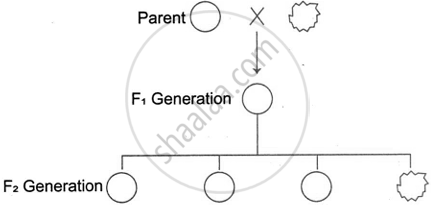
- Which is the dominant and recessive allele of the trait?
- What does the ratio 3 : 1 in the F2 generation represent?
- State Mendel's Law of Dominance.
A pure breeding red flower variety of pea plant (RR) is crossed with a pure breeding white flower variety of pea plant (rr). Draw a Punnett square to find out the Phenotypic and Genotypic ratios of the progeny belonging to the F2 generation.
Explain the term Alleles.
Explain the term ‘Phenotype’?
Solutions for 3: Principles of Genetics
Frank solutions for Biology Part 2 [English] Class 10 ICSE chapter 3 - Principles of Genetics
Shaalaa.com has the CISCE Mathematics Biology Part 2 [English] Class 10 ICSE CISCE solutions in a manner that help students grasp basic concepts better and faster. The detailed, step-by-step solutions will help you understand the concepts better and clarify any confusion. Frank solutions for Mathematics Biology Part 2 [English] Class 10 ICSE CISCE 3 (Principles of Genetics) include all questions with answers and detailed explanations. This will clear students' doubts about questions and improve their application skills while preparing for board exams.
Further, we at Shaalaa.com provide such solutions so students can prepare for written exams. Frank textbook solutions can be a core help for self-study and provide excellent self-help guidance for students.
Concepts covered in Biology Part 2 [English] Class 10 ICSE chapter 3 Principles of Genetics are Gregor Johann Mendel – Father of Genetics, Genes and Genetic, Sex Determination, Genes and their Alleles, Genotype and Phenotype, Autosomes and Sex Chromosomes, Sex-Linked Inheritance in Human Beings, Inheritance in Humans, Monohybrid Cross, Inheritance of Human Traits and Their Genetic Basis, Applications and Beyond Mendel's Laws, Gregor Johann Mendel – Father of Genetics, Genes and Genetic, Sex Determination, Genes and their Alleles, Genotype and Phenotype, Autosomes and Sex Chromosomes, Sex-Linked Inheritance in Human Beings, Inheritance in Humans, Monohybrid Cross, Inheritance of Human Traits and Their Genetic Basis, Applications and Beyond Mendel's Laws.
Using Frank Biology Part 2 [English] Class 10 ICSE solutions Principles of Genetics exercise by students is an easy way to prepare for the exams, as they involve solutions arranged chapter-wise and also page-wise. The questions involved in Frank Solutions are essential questions that can be asked in the final exam. Maximum CISCE Biology Part 2 [English] Class 10 ICSE students prefer Frank Textbook Solutions to score more in exams.
Get the free view of Chapter 3, Principles of Genetics Biology Part 2 [English] Class 10 ICSE additional questions for Mathematics Biology Part 2 [English] Class 10 ICSE CISCE, and you can use Shaalaa.com to keep it handy for your exam preparation.
