Advertisements
Online Mock Tests
Chapters
1: Cell Division
2: Structure of Chromosomes
3: Principles of Genetics
Unit-2 Plant Physiology
4: Absorption by Roots
5: Transpiration
6: Photosynthesis
7: Chemical Coordination in Plants
8: Circulatory System
Unit-3 Human Anatomy and Physiology
▶ 9: Excretory System
10: Nervous System
11: Endocrine System
12: Reproductive System
13: Human Population
14: The Evolution of Man
15: Theories of Evolution
16: Types of Pollution
17: Sources of Pollution and Major Pollutants
18: Effects of Pollution
19: Abatement of Pollution
20: Greenhouse Effects, Global Warming, Ozone Layer Depletion and Acid Rain
![Frank solutions for Biology Part 2 [English] Class 10 ICSE chapter 9 - Excretory System - Shaalaa.com](/images/biology-part-2-english-class-10-icse_6:4cd9978ddb1c4f42b0b0e9ec6f09c057.jpg "Frank solutions for Biology Part 2 [English] Class 10 ICSE chapter 9 - Excretory System")
Advertisements
Solutions for Chapter 9: Excretory System
Below listed, you can find solutions for Chapter 9 of CISCE Frank for Biology Part 2 [English] Class 10 ICSE.
Frank solutions for Biology Part 2 [English] Class 10 ICSE 9 Excretory System Exercises [Pages 127 - 130]
Choose the correct alternative from the choices given below each statement.
Presence of glucose in urine is called ______.
pyuria
glycosuria
haematuria
albuminuria
Choose the correct answer:
Orinithin cycle operates in ________
liver
stomach
pancreas
oral cavity
Choose the correct answer:
Physiologically urea is produced by the action of an enzyme ______________
uricose
urease
arginase
none
Which of these is excreted through urine in mammals?
vitamins
glucose
sodium
all of these
Choose the correct answer:
Excess proteins are converted into urea in ____________
lungs
liver
kidneys
intestine
Choose the correct answer:
The smallest functional unit of the kidney is ____________
glomerulus
Bowman's capsule
nephron
collecting tubule
The nephrons discharge their urine at the ______.
urinary bladder
urethra
renal pelvis
renal pyramid
The pale yellow colour of normal human urine is due to the pigment ______.
Melanin
Anthocyanin
Urochrome
Haemoglobin
The structural and functional units of excretion in the human kidney is the ______.
Ureter
Bowman’s capsule
Renal pelvis
Nephron
Assertion (A): Human body produces highly toxic substances, which if not eliminated may cause death.
Reason (R): Excretory substance removes nitrogenous waste from the body.
Both A and R are true and R is the correct explanation of A.
Both A and R are true but R is not the correct explanation of A.
A is true but R is false.
A is false but R is true.
Assertion (A): In humans, major amount of water is absorbed by the tubular part of nephron.
Reason (R): Absorption of water depends on the dissolved waste to be excreted from the body.
Both A and R are true and R is the correct explanation of A.
Both A and R are true but R is not the correct explanation of A.
A is true but R is false.
A is false but R is true.
Name the following:
Organ which produces urea.
Name the following:
Functional unit of kidney.
Name the following:
Organ which stores urine.
Name the following:
Organ where ultrafiltration occurs.
Name the following:
The pigment that provides yellow colour to urine.
Give a technical term:
The duct which transports urine from the kidney to the urinary bladder.
Name the following:
The main nitrogenous waste formed in the body.
Arrange and rewrite the terms in the group in the correct order to be in a logical sequence beginning with the term that is underlined:
Loop of Henle, Distal convoluted tubule, Bowman’s capsule, Proximal convoluted tubule
Choose the odd one out in the following series:
Proximal convoluted duct, loop of Henle, vein.
Choose the odd one out in the following series:
Kidney, ureter, heart
Choose the odd one out in the following serie:
Urea, uric acid, haemoglobin.
Choose the odd one out in the following series:
Glomerulus, alveoli, bronchi.
Choose the odd one out in the following series:
Renal fat, renal capsule, nerve.
Choose the odd one out in the following serie:
Column of Bertini, minora calyces, brain.
Name the organs that form the excretory system in human beings.
Correct the statement by changing the underlined word.
Normal pale colour of the urine is due to the presence of the pigment Melanin.
Label the diagram given below :

Differentiate between the following pair on the basis of what is indicated in the bracket.
Ureter and Urethra [function]
Give the biological/technical terms for the following:
The hormone increasing reabsorption of water by kidney tubules.
The diagram given alongside shows a section of a human kidney. Study the diagram carefully and answer the questions that follow:
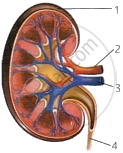
- Label the parts numbered 1 to 4.
- Why does part 2 have a striped appearance?
- What is the fluid that passes down part 4? Name the main nitrogenous waste present in it.
- Mention the structural and functional units of kidneys.
- Name the two major steps in the formation of the fluid mentioned in (c).
The diagram shows the Excretory System of a Human Being. Study the same and then answer the questions that follow:

(i) Name the parts labeled 1, 2,3, and 4.
(ii) Give the main function of the parts labeled 5,6, 7 and 8.
(iii) Name the endocrine gland which could be added in diagram and state its location/position
Given below is a diagram of a human kidney cut open longitudinally. Answer the following:
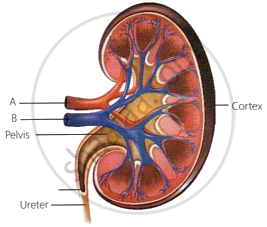
- Give definition of excretion.
- Name the unit of kidney.
- Why does the cortex of kidney show dotted appearance?
- Mention the functions of kidney.
- Write two differences in the composition of the blood flowing through blood vessels A and B.
The diagram given alongside is that of a structure present in a human kidney:
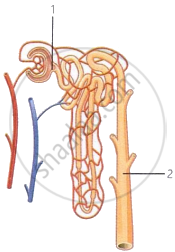
Study the same and answer the questions that follow:
- Name the structure represented in the diagram.
- What is the liquid entering part ‘1’ called?
Name two substances present in this liquid that are reabsorbed in the tubule - What is the fluid that comes to part ‘2’ called? Name the main nitrogenous waste in it.
- Mention the three main steps involved in the formation of the fluid mentioned in (c) above.
- Name the substance which may be present in the fluid in part ‘2’ if a person suffers from Diabetes mellitus
Choose the old one out from the following terms and name the category to which the others belong.
Uterus, Urethra, Urinary bladder, Ureter
The diagram given alongside represents an organ system in the human body. Study the same and answer the questions that follow:
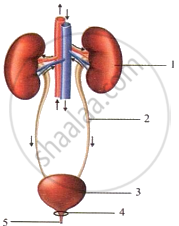
- Identify the system
- Label the parts marked 2 and 4. Mention the function of part 5.
- Name the structural and functional units of the part marked 1.
- What is the fluid that accumulates in part 3?
Which is the main nitrogenous waste present in it? - Draw a neat, labelled diagram showing the longitudinal section of part 1.
The figure alongside shows a part of a nephron. Answer the questions that follow:
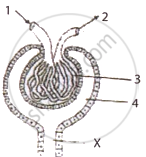
- In which region of the kidney is the above structure present?
- Label the parts numbered 1 to 4.
- What is the technical term for the process that occurs in part 3?
- Why is fluid X not called urine? Justify your answer.
- Draw a neat, labelled diagram of the urinary system of a human.
Draw neat and labelled diagrams of Malpighian capsule
Define the following term:
Ultrafiltration
Solutions for 9: Excretory System
Frank solutions for Biology Part 2 [English] Class 10 ICSE chapter 9 - Excretory System
Shaalaa.com has the CISCE Mathematics Biology Part 2 [English] Class 10 ICSE CISCE solutions in a manner that help students grasp basic concepts better and faster. The detailed, step-by-step solutions will help you understand the concepts better and clarify any confusion. Frank solutions for Mathematics Biology Part 2 [English] Class 10 ICSE CISCE 9 (Excretory System) include all questions with answers and detailed explanations. This will clear students' doubts about questions and improve their application skills while preparing for board exams.
Further, we at Shaalaa.com provide such solutions so students can prepare for written exams. Frank textbook solutions can be a core help for self-study and provide excellent self-help guidance for students.
Concepts covered in Biology Part 2 [English] Class 10 ICSE chapter 9 Excretory System are Structure of a Kidney Tubule (Nephrons), Kidney and Its Internal Structure, Excretion, Function of the Kidney - “Production of Urine”, Urine, Osmoregulation, Dialysis and Artificial Kidney, Afferent Arteriole Vs Efferent Arteriole, The Excretory Organs, Structure of a Kidney Tubule (Nephrons), Kidney and Its Internal Structure, Excretion, Function of the Kidney - “Production of Urine”, Urine, Osmoregulation, Dialysis and Artificial Kidney, Afferent Arteriole Vs Efferent Arteriole, The Excretory Organs.
Using Frank Biology Part 2 [English] Class 10 ICSE solutions Excretory System exercise by students is an easy way to prepare for the exams, as they involve solutions arranged chapter-wise and also page-wise. The questions involved in Frank Solutions are essential questions that can be asked in the final exam. Maximum CISCE Biology Part 2 [English] Class 10 ICSE students prefer Frank Textbook Solutions to score more in exams.
Get the free view of Chapter 9, Excretory System Biology Part 2 [English] Class 10 ICSE additional questions for Mathematics Biology Part 2 [English] Class 10 ICSE CISCE, and you can use Shaalaa.com to keep it handy for your exam preparation.
