Advertisements
Advertisements
Question
The diagram given alongside shows a section of a human kidney. Study the diagram carefully and answer the questions that follow:
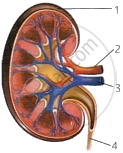
- Label the parts numbered 1 to 4.
- Why does part 2 have a striped appearance?
- What is the fluid that passes down part 4? Name the main nitrogenous waste present in it.
- Mention the structural and functional units of kidneys.
- Name the two major steps in the formation of the fluid mentioned in (c).
Advertisements
Solution
- 1: Cortex
2: Medulla
3: Pelvis
4: Ureter - Medulla is composed of a striped substance arranged in several pyramids. Hence, the medulla (b) has a striped appearance.
- Urine passes down part ‘4’, i.e., the ureter. The main nitrogenous substance present in it is urea.
- Nephrons are the structural and functional units of the kidneys.
- The two major steps in the formation of urine are ultrafiltration and selective reabsorption.
APPEARS IN
RELATED QUESTIONS
The form in which glucose in stored in liver.
The given diagram represents a nephron and its blood supply. Study the diagram and answer the following questions:

(i) Label parts 1, 2, 3 and 4.
(ii) State the reason for the high hydrostatic pressure in the glomerulus.
(iii) Name the blood vessel which contains the least amount of urea in this diagram.
(iv) Name the two main stages of urine formation.
(v) Name the part of the nephron which lies in the renal medulla.
State whether the following statement is true or false:
Some organisms store wastes in body parts.
|
The organs A of a person have been damaged completely due to which too much of a poisonous waste material B has started accumulating in his blood, making it dirty. In order to save this person’s life, the blood from an artery in the person’s arm is made to flow into long tubes made of substance E which are kept in coiled form in a tank containing solution F. This solution contains three materials G, H and I in similar proportions to those in normal blood. As the person’s blood passes through long tubes of substance E, most of the wastes present in it go into solution. The clean blood is then put back into a vein in the arm of the person for circulation. |
- What are organs A?
- Name the waste substance B.
- What are (i) E, and (ii) F?
- Name G, H and I.
- What is the process described above known as?
Explain in your own words with suitable examples.
How is excretion in plants useful to human beings?
Choose the odd one out in the following series:
Renal fat, renal capsule, nerve.
Choose the correct option.
In human beings, uric acid is formed due to metabolism of ______.
Choose the correct option.
Which one of the following organisms excrete waste through nephridia?
“All plants give out oxygen during the day and carbon dioxide during the night”. Do you agree with this statement? Give a reason.
Given below is a list of substances - select the ones that need to be eliminated from the body.
Glucose, excess water, amino acids, urea, carbon dioxide, excess common salt, glycogen, uric acid.
