Advertisements
Advertisements
Question
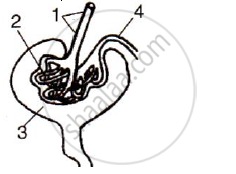
The given diagram represents a nephron and its blood supply. Study the diagram and answer the following questions:

(i) Label parts 1, 2, 3 and 4.
(ii) State the reason for the high hydrostatic pressure in the glomerulus.
(iii) Name the blood vessel which contains the least amount of urea in this diagram.
(iv) Name the two main stages of urine formation.
(v) Name the part of the nephron which lies in the renal medulla.
Advertisements
Solution
(i)
1 – Collecting duct
2 – Distal convoluted tubule (DCT)
3 – Descending limb of loop of Henle
4 – Bowman’s capsule
(ii) The diameter of efferent arteriole is narrower than the diameter of the afferent arteriole which builds the high hydrostatic pressure in the glomerulus.
(iii) Efferent arteriole
(iv) The two main stages of urine formation are ultrafiltration and tubular reabsorption.
(v) Henle’s loop and collecting tubules
APPEARS IN
RELATED QUESTIONS
Why is it necessary to excrete waste products?
What job is done by the kidneys?
Given below is a set of five terms. Rewrite the terms in their correct order so as to be in logical sequence.
Renal artery, urethra, ureter, kidney, urinary bladder.
Study the diagram given alongside and then answer the question that follow:
Name the region in the kidney where the above structure is present?
Name the Following
The substance found in excess in the urine of a diabetic patient.
Give Technical Term:
The tube joining the kidney to the urinary bladder.
Complete the following sentence with appropriate word:
______ supplies blood to kidney.
Choose the correct option.
Specific gravity of urine would _______ if level of ADH increases.
Answer the following question.
Name any one guanotelic organism.
What is the purpose of making urine in the human body?
