Advertisements
Advertisements
प्रश्न
The diagram given alongside shows a section of a human kidney. Study the diagram carefully and answer the questions that follow:
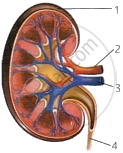
- Label the parts numbered 1 to 4.
- Why does part 2 have a striped appearance?
- What is the fluid that passes down part 4? Name the main nitrogenous waste present in it.
- Mention the structural and functional units of kidneys.
- Name the two major steps in the formation of the fluid mentioned in (c).
Advertisements
उत्तर
- 1: Cortex
2: Medulla
3: Pelvis
4: Ureter - Medulla is composed of a striped substance arranged in several pyramids. Hence, the medulla (b) has a striped appearance.
- Urine passes down part ‘4’, i.e., the ureter. The main nitrogenous substance present in it is urea.
- Nephrons are the structural and functional units of the kidneys.
- The two major steps in the formation of urine are ultrafiltration and selective reabsorption.
APPEARS IN
संबंधित प्रश्न
Correct the statement by changing the underlined word.
Normal pale colour of the urine is due to the presence of the pigment Melanin.
What is urethra?
Correct and rewrite the statement by changing the biological term that is underlined for the statement:
The kidney is composed of number of neurons.
Study the diagram given alongside and then answer the question that follow:
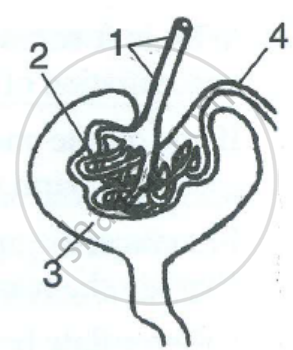
What is the technical term given to the process occurring in 2 and 3? Briefly describe the process.
The diagram below represents a mammalian kidney tubule (nephron) and its blood supply. Parts indicated by the guidelines 1 to 8 are as follows:
1. U-shaped loop of Henle
2. Proximal convoluted tubule with blood capillaries
3. Bowman’s capsule
4. Afferent arteriole from the renal artery
5. Glomerulus
6. Venule to the renal vein
7. Collecting tubule
8. Distal convoluted tubule with blood capillaries Study the diagram and answer the following questions in each case:
(i) Where does ultrafiltration take place?
(ii) Which structure contains the lowest concentration of urea?
(iii) Which structure contains the highest concentration of urea?
(iv) Which structure contains the lowest concentration of glucose?
(v) Where is the most water reabsorbed?
Name the Following
The process by which kidneys regulate the water content of the body.
Complete the following sentence with appropriate words:
The outer surface of the kidney is ______ while the inner surface is ______.
Hypotonic filtrate is formed in _______.
Complete the diagram/chart with correct labels/ information. Write the conceptual details regarding it.
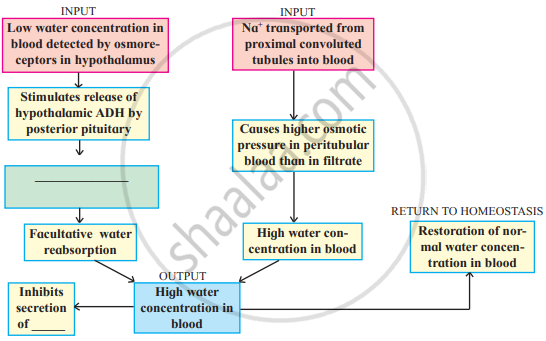
The main nitrogenous waste formed in the human body:
