Advertisements
Advertisements
प्रश्न
Answer the following in detail.
Explain the process of transpiration. Describe some factors that affect it.
Advertisements
उत्तर
Large quantities of water are absorbed by plants for photosynthesis and other processes. Excess of water is lost in the form of water vapour through the stomata and lenticels from the aerial parts of the plant by transpiration. It helps plants to maintain the concentration of sap inside the plant body. If plants do not remove excess water through transpiration, the dilute sap will prevent further absorption of water and minerals from the soil.
Factors affecting the rate of transpiration are :
- Sunlight: Rate of transpiration is more during the day as stomata are open. Stomata remain closed at night and thus no transpiration takes at night.
- Temperature: Transpiration is more on hot days than on cold days.
- Wind: Blowing wind removes water vapour faster from the leaves and hence transpiration rate increases.
- Humidity: If the air is humid, the rate of transpiration is low.
In the rainy season, transpiration is less since humidity is more.
APPEARS IN
संबंधित प्रश्न
Explain Selective reabsorption
Name the basic filtration unit present in the kidney.
Name the procedure used in the working of artificial kidney.
The excretory organs in an earthworm are ______.
Write down the functional activity of the following parts,
Renal artery ………………
The following diagram represents a mammalian kidney tubule (nephron) and its blood supply.
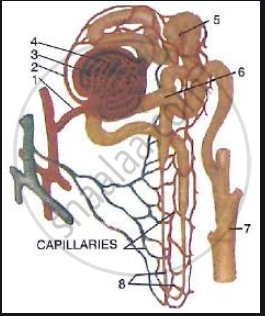
Parts indicated by the guidelines 1to 8 are as follows:
1. Afferent arteriole from renal artery
2. Efferent arteriole
3. Bowman's capsule
4. Glomerulus
5. Proximal convoluted tubule with blood capillaries
6. Distal convoluted tubule with blood capillaries
7. Collecting tubule
8. U-shaped loop of Henle
Study the diagram and answer the question that follow:
Which structure contains the highest concentration of urea?
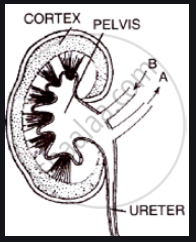
Given below is a highly simplified diagram of the human kidney cut open longitudinally. Answer the question that follow:
Mention two functions of the kidney.
Explain the Term: Glomerulus
Complete the following sentence with appropriate words:
The outer surface of the kidney is ______ while the inner surface is ______.
Explain the importance of soil for plant growth.
