Advertisements
Advertisements
प्रश्न
The following diagram represents a mammalian kidney tubule (nephron) and its blood supply.
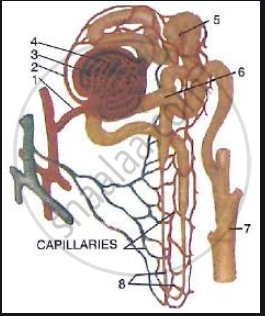
Parts indicated by the guidelines 1to 8 are as follows:
1. Afferent arteriole from renal artery
2. Efferent arteriole
3. Bowman's capsule
4. Glomerulus
5. Proximal convoluted tubule with blood capillaries
6. Distal convoluted tubule with blood capillaries
7. Collecting tubule
8. U-shaped loop of Henle
Study the diagram and answer the question that follow:
Which structure contains the highest concentration of urea?
Advertisements
उत्तर
1/ Afferent arteriole from renal artery
संबंधित प्रश्न
Describe the structure of nephrons.
Write the functions of Kidney
A dialysis machine contains long tubes coiled in a tank containing dialysing solution:
What does the dialysing solution contain?
Fill in the blank.
.................. produces bile pigments from the heamoglobin of broken RBCs.
Explain the difference between the excretory system of humans and plants.
Study the diagram given alongside and then answer the question that follow:
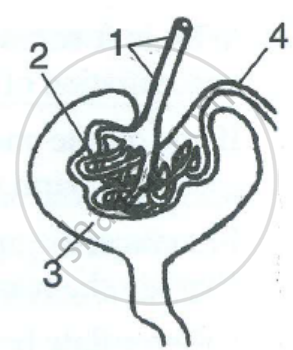
What is the technical term given to the process occurring in 2 and 3? Briefly describe the process.
Complete the following sentence with appropriate word:
The sum total of all the chemical reactions taking place in the cell is known as ______.
In order to maintain homeostasis or constant internal environment . ______' is essential.
“All plants give out oxygen during the day and carbon dioxide during the night”. Do you agree with this statement? Give a reason.
Two green plants are kept separately in oxygen-free containers, one in the dark and the other in continuous light. Which one will live longer? Give reasons.
