Advertisements
Advertisements
प्रश्न
The following diagram represents a mammalian kidney tubule (nephron) and its blood supply.
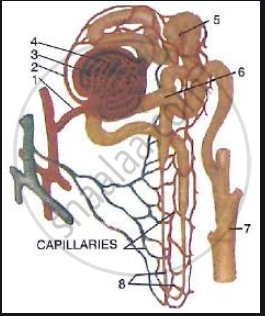
Parts indicated by the guidelines 1to 8 are as follows:
1. Afferent arteriole from renal artery
2. Efferent arteriole
3. Bowman's capsule
4. Glomerulus
5. Proximal convoluted tubule with blood capillaries
6. Distal convoluted tubule with blood capillaries
7. Collecting tubule
8. U-shaped loop of Henle
Study the diagram and answer the question that follow:
Which structure contains the highest concentration of urea?
Advertisements
उत्तर
1/ Afferent arteriole from renal artery
संबंधित प्रश्न
The nephrons discharge their urine at ______.
Give the biological/technical terms for the following:
The hormone increasing reabsorption of water by kidney tubules.
Where is the dirty blood in our body filtered?
Write True (T) or False (F) for the following statement. Rewrite the false statement in the correct form.
Excess sugar in the blood is a symptom of diabetes.
Answer the following in short.
Define transpiration in plants.
Given below is a simplified diagram of the human kidney cut open longitudinally. Answer the questions that follow.
 |
- Define excretion.
- Why does the cortex of the kidney show a dotted appearance?
- Why does the medulla of the kidney show a striped appearance?
- Write two differences in the composition of the blood flowing through the blood vessels 'A' and 'B'.
Differentiate between:
Renal cortex and Renal medulla.
Write the functional activity of the following structure: Renal artery
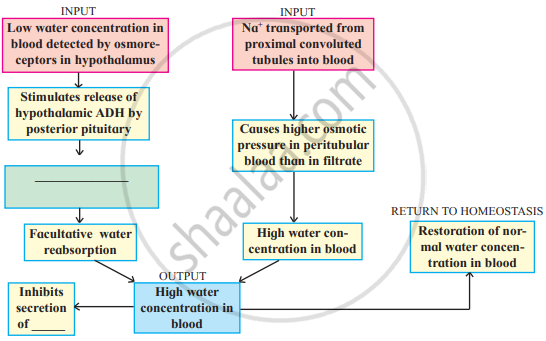
Complete the diagram/chart with correct labels/ information. Write the conceptual details regarding it.
Give two examples of the following:
Bile pigments
