Advertisements
Advertisements
प्रश्न
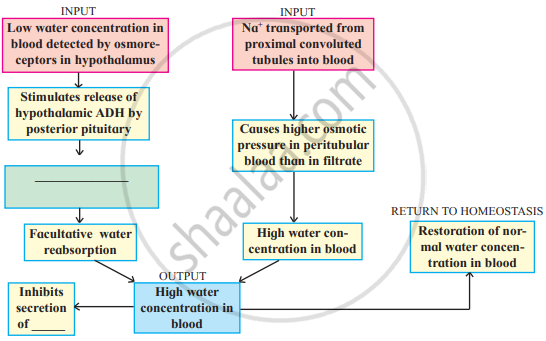
Complete the diagram/chart with correct labels/ information. Write the conceptual details regarding it.
Advertisements
उत्तर
The composition of urine depends upon food and fluid consumed by an individual. There are two ways in which it the composition is regulated. They are as follows:
- Regulating water reabsorption through ADH:
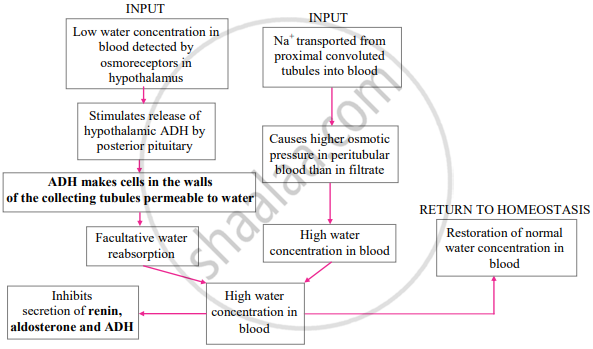
Hypothalamus in the midbrain has special receptors called osmoreceptors which can detect a change in osmolarity (measure of a total number of dissolved particles per liter of solution) of blood. If osmolarity of blood increases due to water loss from the body (after eating namkeen or due to sweating), osmoreceptors trigger the release of Antidiuretic hormone (ADH) from neurohypophysis (posterior pituitary). ADH stimulates reabsorption of water from the last part of DCT and the entire collecting duct by increasing the permeability of cells. This leads to a reduction in urine volume and a decrease in osmolarity of blood. Once the osmolarity of blood comes to normal, the activity of osmoreceptor cells decreases leading to a decrease in ADH secretion. This is called negative feedback. In case of hemorrhage or severe dehydration too, osmoreceptors stimulate ADH secretion. ADH is important in regulating water balance through the kidneys. In absence of ADH, diuresis (dilution of urine) takes place and person tends to excrete large amounts of dilute urine. This condition called diabetes insipidus. - Electrolyte reabsorption through RAAS:
Another regulatory mechanism is RAAS (Renin Angiotensin Aldosterone System) by Juxta Glomerular Apparatus (JGA). Whenever blood supply (due to change in blood pressure or blood volume) to afferent arteriole decreases (e.g. low BP/dehydration), JGA cells release Renin. Renin converts angiotensinogen secreted by hepatocytes in the liver to Angiotensin I. ‘Angiotensin-converting enzyme’ further modifies Angiotensin I to Angiotensin II, the active form of the hormone. It stimulates the adrenal cortex to release another hormone called aldosterone that stimulates DCT and collecting ducts to reabsorb more Na+ and water, thereby increasing blood volume and pressure. - Atrial natriuretic peptide (ANP):
A large increase in blood volume and pressure stimulates the atrial wall to produce atrial natriuretic peptide (ANP). ANP inhibits Na+ and Cl– reabsorption from collecting ducts inhibits the release of renin, reduces aldosterone and ADH release too. This leads to a condition called Natriuresis (increased excretion of Na+ in urine) and diuresis.
APPEARS IN
संबंधित प्रश्न
Mention the exact location of the Prostate gland.
What job is done by the kidneys?
A dialysis machine contains long tubes coiled in a tank containing dialysing solution:
Of what substance are the tubes made?
Name the following:
The outer region of kidney containing the Bowman's capsule.
Write down the functional activity of the following parts,
Renal artery ………………
Look at the figure given bellow, it is a section of human kidney as seen from the front.

Is it a longitudinal section or a cross-section?
Correct and rewrite the statement by changing the biological term that is underlined for the statement:
The kidney is composed of number of neurons.
Name the Following
The Inner concave margin of kidney.
Answer the following question.
State the role of liver in urea production.
Salt excreting glands are found near ______ in marine birds like Albatross.
