Advertisements
Advertisements
प्रश्न
Complete the diagram/chart with correct labels/ information. Write the conceptual details regarding it.
Advertisements
उत्तर
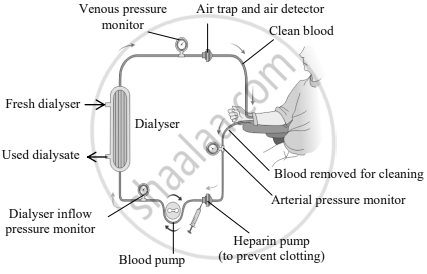
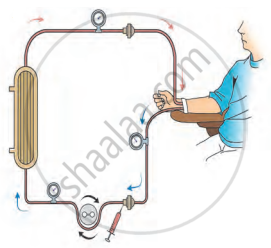
- When the renal function of a person falls below 5 – 7 %, the accumulation of harmful substances in the blood begins. In such a condition, the person has to go for artificial means of filtration of blood i.e. hemodialysis.
- In haemodialysis, a dialysis machine is used to filter blood. The blood is filtered outside the body using a dialysis unit.
- In this procedure, the patients’ blood is removed; generally from the radial artery and passed through a cellophane tube that acts as a semipermeable membrane.
- The tube is immersed in a fluid called dialysate which is isosmotic to normal blood plasma. Hence, only excess salts if present in plasma pass through the cellophane tube into the dialysate.
- Waste substances being absent in the dialysate, move from the blood into the dialyzing fluid.
- The filtered blood is returned to vein.
- In this process it is essential that anticoagulant like heparin is added to the blood while it passing through the tube and before resending it into the circulation, an adequate amount of anti-heparin is mixed.
- Also, the blood has to move slowly through the tube and hence the process is slow.
APPEARS IN
संबंधित प्रश्न
What are the two ways by which a person can get relief in case of kidney failure?
Draw a diagram of the human excretory system and label the following parts: Kidney, ureter, urinary bladder, and urethra.
Answer the following question.
John has two options as a treatment for his renal problem: Dialysis or kidney transplants. Which option should he choose? Why?
Complete the diagram/chart with correct labels/ information. Write the conceptual details regarding it.
Dialysis is an imperfect treatment because ______
Match the abnormal conditions given in Column A with their explanations given in Column B and Choose the correct option
| Column A | Column B |
| A. Glycosuria | i. Accumulation of uric acid in joints |
| B. Renal calculi | ii. Inflammation in glomeruli |
| C. Glomerular nephritis | iii. Mass of crystallised salts within the kidney |
| D. Gout | iv. Presence of glucose in urine |
What is the procedure advised for the correction of extreme renal failure? Give a brief account of it.
Which of the following conditions does not lead to acute renal failure?
Which of the following statement is true regarding kidney or renal transplantation?
Which one of the following is CORRECT regarding struvite stones in kidney?
I. These are formed in response to bacterial infection.
II. It is a genetic disorder.
III. These grow quickly and become quite large.
IV. Occurs in people who consume a high-protein diet.
V. Affected people excrete too much of certain amino acid.
