Advertisements
Advertisements
प्रश्न
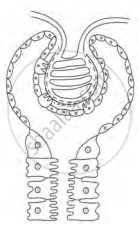
Complete the diagram/chart with correct labels/ information. Write the conceptual details regarding it.
Advertisements
उत्तर
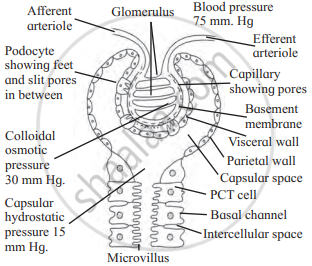
Malpighian body-
Nephron is the structural and functional unit of kidney.
Malpighian body: Each Malpighian body is about 200μm in diameter and consists of a Bowman’s capsule and glomerulus.
- Glomerulus:
Glomerulus is a bunch of fine blood capillaries located in the cavity of Bowman’s capsule. A small terminal branch of the renal artery, called as afferent arteriole enters the cup cavity (Bowman capsule) and undergoes extensive fine branching to form network of several capillaries. This bunch is called as glomerulus. The capillary wall is fenestrated (perforated). All capillaries reunite and form an efferent arteriole that leaves the cup cavity. The diameter of the afferent arteriole is greater than the efferent arteriole. This creates a high hydrostatic pressure essential for ultrafiltration, in the glomerulus. - Bowman’s capsule:
It is a cup-like structure having double walls composed of squamous epithelium. The outer wall is called as parietal wall and the inner wall is called as visceral wall. The parietal wall is thin consisting of simple squamous epithelium. There is a space called as capsular space / urinary space in between two walls. Visceral wall consists of special type of squamous cells called podocytes having a foot-like pedicel. These podocytes are in close contact with the walls of capillaries of glomerulus. There are small slits called as filtration slits in between adjacent podocytes.
APPEARS IN
संबंधित प्रश्न
Name the Following
The organ which produces urea.
Name the two parts of a plant through which its gaseous waste products are released into the air.
What does the bladder in our body do?
Write down the functional activity of the following parts,
Renal artery ………………
Define the following term:
Micturition
Complete the following sentence with appropriate word:
Human kidney is made up of ______.
State the Location: Renal pyramids
In a person the tubule part of the nephron is not functioning at all. What will its effect be on urine formation?
Give two examples of the following:
Water-soluble vitamins
Name the following;
Three nitrogenous wastes of our body.
