Advertisements
Advertisements
प्रश्न
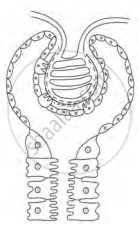
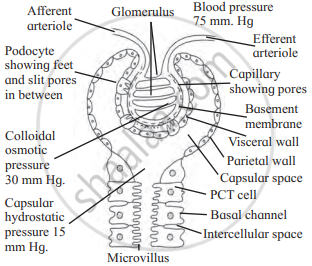
Complete the diagram/chart with correct labels/ information. Write the conceptual details regarding it.
Advertisements
उत्तर
Malpighian body-
Nephron is the structural and functional unit of kidney.
Malpighian body: Each Malpighian body is about 200μm in diameter and consists of a Bowman’s capsule and glomerulus.
- Glomerulus:
Glomerulus is a bunch of fine blood capillaries located in the cavity of Bowman’s capsule. A small terminal branch of the renal artery, called as afferent arteriole enters the cup cavity (Bowman capsule) and undergoes extensive fine branching to form network of several capillaries. This bunch is called as glomerulus. The capillary wall is fenestrated (perforated). All capillaries reunite and form an efferent arteriole that leaves the cup cavity. The diameter of the afferent arteriole is greater than the efferent arteriole. This creates a high hydrostatic pressure essential for ultrafiltration, in the glomerulus. - Bowman’s capsule:
It is a cup-like structure having double walls composed of squamous epithelium. The outer wall is called as parietal wall and the inner wall is called as visceral wall. The parietal wall is thin consisting of simple squamous epithelium. There is a space called as capsular space / urinary space in between two walls. Visceral wall consists of special type of squamous cells called podocytes having a foot-like pedicel. These podocytes are in close contact with the walls of capillaries of glomerulus. There are small slits called as filtration slits in between adjacent podocytes.
APPEARS IN
संबंधित प्रश्न
What is the role of glomerulus in the kidney?
What job is done by the kidneys?
A dialysis machine contains long tubes coiled in a tank containing dialysing solution:
Of what substance are the tubes made?
|
The organs A of a person have been damaged completely due to which too much of a poisonous waste material B has started accumulating in his blood, making it dirty. In order to save this person’s life, the blood from an artery in the person’s arm is made to flow into long tubes made of substance E which are kept in coiled form in a tank containing solution F. This solution contains three materials G, H and I in similar proportions to those in normal blood. As the person’s blood passes through long tubes of substance E, most of the wastes present in it go into solution. The clean blood is then put back into a vein in the arm of the person for circulation. |
- What are organs A?
- Name the waste substance B.
- What are (i) E, and (ii) F?
- Name G, H and I.
- What is the process described above known as?
Given below is a set of five terms. Rewrite the terms in their correct order so as to be in logical sequence.
Renal artery, urethra, ureter, kidney, urinary bladder.
Look at the figure given bellow, it is a section of human kidney as seen from the front.

Is it a longitudinal section or a cross-section?
Choose the odd one out in the following series:
Renal fat, renal capsule, nerve.
Label the diagram given below :

Choose the correct option.
What is micturition?
Give two examples of the following:
Nitrogenous waste
