Advertisements
Advertisements
प्रश्न
Given below is a simplified diagram of the human kidney cut open longitudinally. Answer the questions that follow.
 |
- Define excretion.
- Why does the cortex of the kidney show a dotted appearance?
- Why does the medulla of the kidney show a striped appearance?
- Write two differences in the composition of the blood flowing through the blood vessels 'A' and 'B'.
Advertisements
उत्तर
- The process of removal of chemical wastes (mainly nitrogenous wastes) from the body is known as 'excretion'.
- Due to both Bowman's capsule and the proximal convoluted part lying in it.
- Henle's loops and collecting ducts in the medulla of the kidneys create a striped or striated look.
-
- Renal Artery: The blood vessel 'B', i.e., the renal artery, contains dirty blood.
Renal Vein: The blood vessel 'A', i.e., the renal vein, contains cleaned blood. - Renal Artery: It pours the blood into the glomerulus and Bowman's capsule.
Renal Vein: It pours blood into the postvena cava. Blood arteries A and B open into the medulla, not the pelvis or ureter.
- Renal Artery: The blood vessel 'B', i.e., the renal artery, contains dirty blood.
APPEARS IN
संबंधित प्रश्न
Write the functions of Kidney
Correct the statement by changing the underlined word.
Normal pale colour of the urine is due to the presence of the pigment Melanin.
The diagram given alongside is that of a structure present in a human kidney:
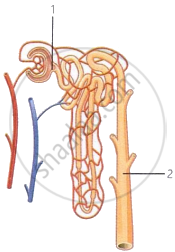
Study the same and answer the questions that follow:
- Name the structure represented in the diagram.
- What is the liquid entering part ‘1’ called?
Name two substances present in this liquid that are reabsorbed in the tubule - What is the fluid that comes to part ‘2’ called? Name the main nitrogenous waste in it.
- Mention the three main steps involved in the formation of the fluid mentioned in (c) above.
- Name the substance which may be present in the fluid in part ‘2’ if a person suffers from Diabetes mellitus
A dialysis machine contains long tubes coiled in a tank containing dialysing solution:
Of what substance are the tubes made?
What is urethra?
Explain the functioning of kidney.
Give Technical Term:
The organ which filters out urea and uric acid from the bloodstream.
Among the following animals, the best conserver of water is ______.
Explain the importance of soil for plant growth.
Choose the odd one out in the following set and write the category for the remaining term:
Ammonia, urea, excess sodium chloride, uric acid
