Advertisements
Advertisements
प्रश्न
Study the diagram given below and then answer the questions that follow:
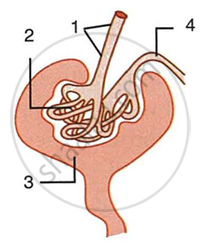 |
- Name the region in the kidney where the above structure is present?
- Name the parts labelled 1, 2, 3 and 4.
- Name the stages involved in the formation of urine.
- What is the technical term given to the process occurring in 2 and 3? Briefly describe the process.
Advertisements
उत्तर
- Renal cortex
-
- Afferent arteriole
- Glomerulus
- Bowman's capsule
- Efferent arteriole
- Ultrafiltration, tubular reabsorption, and tubular secretion.
- The process occurring in 2 and 3 is known as ultrafiltration.
Ultrafiltration: The blood flows through the glomerulus under great pressure, much greater than in the capillaries elsewhere. The reason for this greater pressure is that the efferent (outgoing) arteriole is narrower than the afferent (incoming) arteriole. This high pressure (hydrostatic pressure) causes the liquid part of the blood to filter out from the glomerulus into the renal tubule. This filtration under extraordinary force is called ultrafiltration.
APPEARS IN
संबंधित प्रश्न
Bowman’s capsule and tubule taken together make a ______.
Answer the following in short.
What is excretion?
Write down the functional activity of the following parts,
Henle's loop ………………
Choose the correct answer:
Composition of extracellular fluid is regulated by ___________
The following diagram represents a mammalian kidney tubule (nephron) and its blood supply.
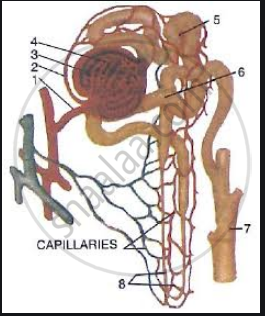
Parts indicated by the guidelines 1to 8 are as follows:
1. Afferent arteriole from renal artery
2. Efferent arteriole
3. Bowman's capsule
4. Glomerulus
5. Proximal convoluted tubule with blood capillaries
6. Distal convoluted tubule with blood capillaries
7. Collecting tubule
8. U-shaped loop of Henle
Study the diagram and answer the question that follow:
Where is most water reabsorbed ?
Given below is a simple diagram of the human kidney cut open longitudinally. Answer the following questions: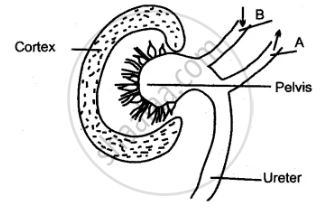
c
(v) Write two differences in the composition of the blood flowing through blood vessels A and B.
Give Technical Term:
The tube joining the kidney to the urinary bladder.
Give a technical term:
The duct which transports urine from the kidney to the urinary bladder.
The tadpole of frog lives in water, hence its mode of excretion is ______.
The product of the process of deamination is ______.
