Advertisements
Advertisements
प्रश्न
Study the diagram given below and then answer the questions that follow:
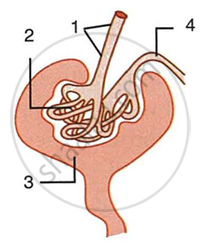 |
- Name the region in the kidney where the above structure is present?
- Name the parts labelled 1, 2, 3 and 4.
- Name the stages involved in the formation of urine.
- What is the technical term given to the process occurring in 2 and 3? Briefly describe the process.
Advertisements
उत्तर
- Renal cortex
-
- Afferent arteriole
- Glomerulus
- Bowman's capsule
- Efferent arteriole
- Ultrafiltration, tubular reabsorption, and tubular secretion.
- The process occurring in 2 and 3 is known as ultrafiltration.
Ultrafiltration: The blood flows through the glomerulus under great pressure, much greater than in the capillaries elsewhere. The reason for this greater pressure is that the efferent (outgoing) arteriole is narrower than the afferent (incoming) arteriole. This high pressure (hydrostatic pressure) causes the liquid part of the blood to filter out from the glomerulus into the renal tubule. This filtration under extraordinary force is called ultrafiltration.
APPEARS IN
संबंधित प्रश्न
How is the amount of urine produced regulated?
The kidneys in human beings are a part of the system for ______.
Gums and resins are the ______ products of plants.
A dialysis machine contains long tubes coiled in a tank containing dialysing solution:
Name the main waste which passes into the dialysing solution.
Choose the correct answer:
A condition of failure of kidney to form urea is called ____________
Choose the correct answer:
The smallest functional unit of the kidney is ____________
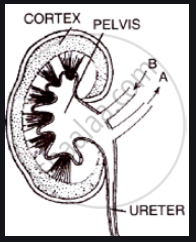
Given below is a highly simplified diagram of the human kidney cut open longitudinally. Answer the question that follow:
Mention two functions of the kidney.
Choose the Odd One Out:
The product of the process of deamination is ______.
What is the purpose of making urine in the human body?
