Advertisements
Advertisements
Question
Study the diagram given below and then answer the questions that follow:
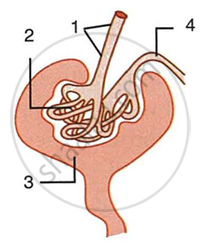 |
- Name the region in the kidney where the above structure is present?
- Name the parts labelled 1, 2, 3 and 4.
- Name the stages involved in the formation of urine.
- What is the technical term given to the process occurring in 2 and 3? Briefly describe the process.
Advertisements
Solution
- Renal cortex
-
- Afferent arteriole
- Glomerulus
- Bowman's capsule
- Efferent arteriole
- Ultrafiltration, tubular reabsorption, and tubular secretion.
- The process occurring in 2 and 3 is known as ultrafiltration.
Ultrafiltration: The blood flows through the glomerulus under great pressure, much greater than in the capillaries elsewhere. The reason for this greater pressure is that the efferent (outgoing) arteriole is narrower than the afferent (incoming) arteriole. This high pressure (hydrostatic pressure) causes the liquid part of the blood to filter out from the glomerulus into the renal tubule. This filtration under extraordinary force is called ultrafiltration.
APPEARS IN
RELATED QUESTIONS
_____________ secreted by the (ii) _____________ lobe of the pituitary gland. If this hormone secretion is reduced, there is an increased production of urine. This disorder is called (iii) ____________. Sometimes excess glucose is passed with urine due to hyposecretion of another hormone called (iv) _____________ leading to the cause of a disease called (v) ______________.
Gums and resins are the ______ products of plants.
Define excretion.
Answer the following in short.
What is excretion?
Answer the following in detail.
Explain the process of transpiration. Describe some factors that affect it.
Given below is a set of five terms. Rewrite the terms in their correct order so as to be in logical sequence.
Renal artery, urethra, ureter, kidney, urinary bladder.
Given below is a highly simplified diagram of the human kidney cut open longitudinally. Answer the question that follow:
Why does the cortex of the kidney show a dotted appearance?

Name the Following
The substance found in excess in the urine of a diabetic patient.
Complete the following sentence with appropriate word:
The U-shaped portion of a nephron located in the medulla region is called ______.
Explain the importance of soil for plant growth.
