Advertisements
Advertisements
Question
_____________ secreted by the (ii) _____________ lobe of the pituitary gland. If this hormone secretion is reduced, there is an increased production of urine. This disorder is called (iii) ____________. Sometimes excess glucose is passed with urine due to hyposecretion of another hormone called (iv) _____________ leading to the cause of a disease called (v) ______________.
Advertisements
Solution
Anti-diuretic hormone (ADH) secreted by the (ii) Posterior lobe of the pituitary gland. If this hormone secretion is reduced, there is an increased production of urine. This disorder is called Diabetes insipidus (iii) . Sometimes excess glucose is passed with urine due to hyposecretion of another hormone called (iv) Vasopressin leading to the cause of a disease called (v) Blood pressure.
APPEARS IN
RELATED QUESTIONS
Name a waste gas released by the plants only during the night time.
Fill in the blank :
Nitrogenous wastes in the urine are in the form of urea and .....................
Look at the figure given below. It is a section of human kidney as seen from the front.
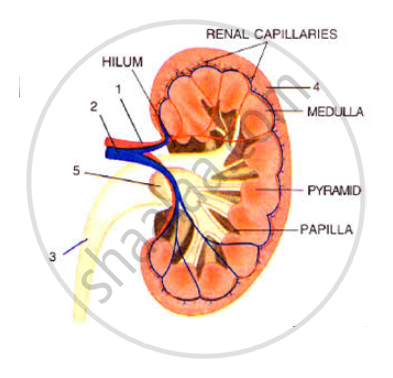
Which area/part (give its name and number given on the diagram) which contains the following:
(i) Malpighian capsule
(ii) The pyramids
(iii) Freshly collected urine
Given below is a highly simplified diagram of the human kidney cut open longitudinally. Answer the question that follow:
Name the functional units of the kidneys.
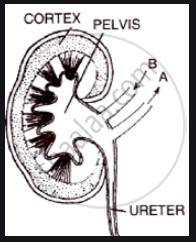
Study the diagram given alongside and then answer the question that follow:
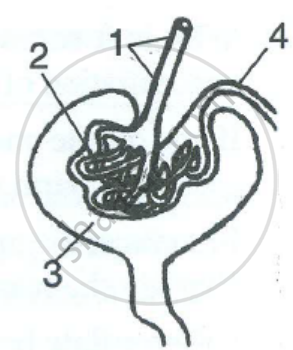
Name the parts labelled 1, 2, 3, and 4.
Differentiate between:
Ureter and Urethra.
The diagram below represents a mammalian kidney tubule (nephron) and its blood supply. Parts indicated by the guidelines 1 to 8 are as follows:
1. U-shaped loop of Henle
2. Proximal convoluted tubule with blood capillaries
3. Bowman’s capsule
4. Afferent arteriole from the renal artery
5. Glomerulus
6. Venule to the renal vein
7. Collecting tubule
8. Distal convoluted tubule with blood capillaries Study the diagram and answer the following questions in each case:
(i) Where does ultrafiltration take place?
(ii) Which structure contains the lowest concentration of urea?
(iii) Which structure contains the highest concentration of urea?
(iv) Which structure contains the lowest concentration of glucose?
(v) Where is the most water reabsorbed?
Choose the Odd One Out:
Choose the correct option.
Which one of the following organisms would spend maximum energy in the production of nitrogenous waste?
Choose the odd one out in the following set and write the category for the remaining term:
Ammonia, urea, excess sodium chloride, uric acid
