Advertisements
Advertisements
Question
Choose the Odd One Out:
Options
Proximal convoluted tubule
Distal convoluted tubule
Henle’s loop
Renal corpuscle
Advertisements
Solution
Renal corpuscle
RELATED QUESTIONS
What do kidneys excrete?
How are waste products excreted in Amoeba?
Explain in your own words with suitable examples.
How does excretion occur in human beings?
Study the diagram given alongside and then answer the question that follow:
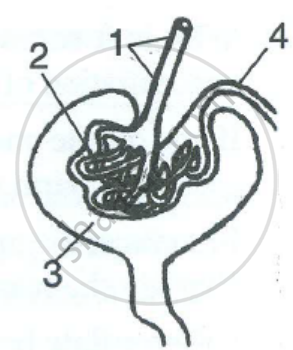
Name the stages involved in the formation of urine.
The diagram below represents a mammalian kidney tubule (nephron) and its blood supply. Parts indicated by the guidelines 1 to 8 are as follows:
1. U-shaped loop of Henle
2. Proximal convoluted tubule with blood capillaries
3. Bowman’s capsule
4. Afferent arteriole from the renal artery
5. Glomerulus
6. Venule to the renal vein
7. Collecting tubule
8. Distal convoluted tubule with blood capillaries Study the diagram and answer the following questions in each case:
(i) Where does ultrafiltration take place?
(ii) Which structure contains the lowest concentration of urea?
(iii) Which structure contains the highest concentration of urea?
(iv) Which structure contains the lowest concentration of glucose?
(v) Where is the most water reabsorbed?
Explain the Term: Ureter
Name the Following
The substance found in excess in the urine of a diabetic patient.
Complete the following sentence with appropriate words:
The outer surface of the kidney is ______ while the inner surface is ______.
Choose the correct option.
In human beings, uric acid is formed due to metabolism of ______.
Hypotonic filtrate is formed in _______.
