Advertisements
Advertisements
Question
Study the diagram given alongside and then answer the question that follow:
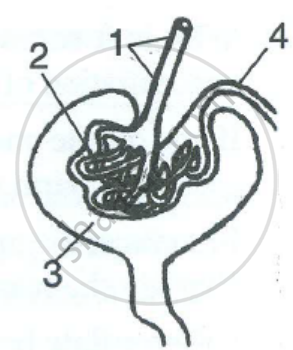
Name the stages involved in the formation of urine.
Advertisements
Solution
Urine formation occurs in two steps - ultrafiltration and reabsorption.
RELATED QUESTIONS
Describe the structure of nephrons.
Explain the principle of dialysis with the help of a labelled diagram.
Name the following:
The tuft of capillaries inside the Bowman's capsule.
Fill in the blanks in the following passage to make it a meaningful description.
In a nephron, the ______ flows through the ______ under great pressure. The reason for this great pressure is that the ______ (outgoing) ______ is narrower than the ______ (incoming). This high pressure causes the ______ part of the blood to filter out from the ______ into the ______ capsule.
Label the diagram given below :

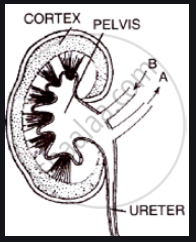
Given below is a highly simplified diagram of the human kidney cut open longitudinally. Answer the question that follow:
Mention two functions of the kidney.
Choose the Odd One Out:
The CORRECT match is ______.
Two green plants are kept separately in oxygen-free containers, one in the dark and the other in continuous light. Which one will live longer? Give reasons.
Give two examples of the following:
Water-soluble vitamins
