Advertisements
Advertisements
Question
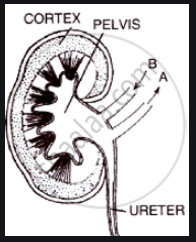
Given below is a highly simplified diagram of the human kidney cut open longitudinally. Answer the question that follow:
Mention two functions of the kidney.
Advertisements
Solution
Kidneys help in removing wastes or excretion and osmoregulation.
RELATED QUESTIONS
Name an animal which absorbs oxygen through its moist skin.
Name the following:
The vein in which urea concentration is maximum
Given below is a set of five terms. Rewrite the terms in their correct order so as to be in logical sequence.
Afferent arteriole, renal vein, secondary capillary network, glomerulus, efferent arteriole.
The following diagram represents a mammalian kidney tubule (nephron) and its blood supply.
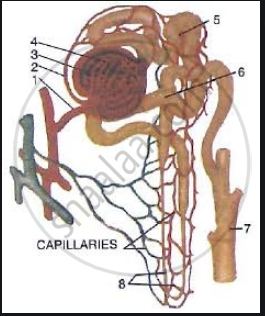
Parts indicated by the guidelines 1to 8 are as follows:
1. Afferent arteriole from renal artery
2. Efferent arteriole
3. Bowman's capsule
4. Glomerulus
5. Proximal convoluted tubule with blood capillaries
6. Distal convoluted tubule with blood capillaries
7. Collecting tubule
8. U-shaped loop of Henle
Study the diagram and answer the question that follow:
Which structure contains the highest concentration of urea?
Study the diagram given alongside and then answer the question that follow:
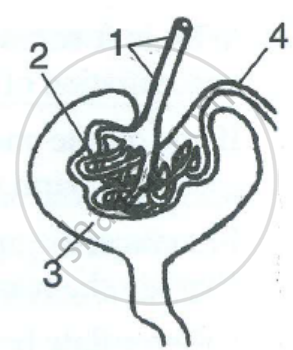
What is the technical term given to the process occurring in 2 and 3? Briefly describe the process.
Name the Following
The process by which kidneys regulate the water content of the body.
Complete the following sentence with appropriate word:
Human kidney is made up of ______.
The product of the process of deamination is ______.
Elimination of nitrogenous wastes in the form of uric acid takes place in ____________.
Among the following animals, the best conserver of water is ______.
