Advertisements
Advertisements
Question
The following diagram represents a mammalian kidney tubule (nephron) and its blood supply.
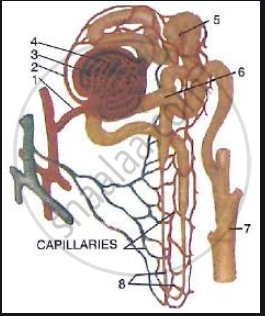
Parts indicated by the guidelines 1to 8 are as follows:
1. Afferent arteriole from renal artery
2. Efferent arteriole
3. Bowman's capsule
4. Glomerulus
5. Proximal convoluted tubule with blood capillaries
6. Distal convoluted tubule with blood capillaries
7. Collecting tubule
8. U-shaped loop of Henle
Study the diagram and answer the question that follow:
Which structure contains the highest concentration of urea?
Advertisements
Solution
1/ Afferent arteriole from renal artery
RELATED QUESTIONS
Explain Selective reabsorption
Correct the statement by changing the underlined word.
Normal pale colour of the urine is due to the presence of the pigment Melanin.
Answer the following in short.
What is excretion?
Write down the functional activity of the following parts,
Renal artery ………………
Define the following term:
Micturition
Correct and rewrite the statement by changing the biological term that is underlined for the statement:
The kidney is composed of number of neurons.
Explain in your own words with suitable examples.
How does excretion occur in human beings?
Explain in your own words with suitable examples.
How is excretion in plants useful to human beings?
Complete the following sentence with appropriate word:
The sum total of all the chemical reactions taking place in the cell is known as ______.
“All plants give out oxygen during the day and carbon dioxide during the night”. Do you agree with this statement? Give a reason.
