Advertisements
Advertisements
प्रश्न
Study the diagram given alongside and then answer the question that follow:
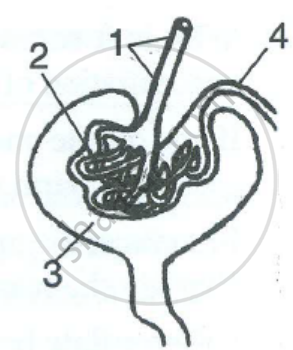
Name the stages involved in the formation of urine.
Advertisements
उत्तर
Urine formation occurs in two steps - ultrafiltration and reabsorption.
संबंधित प्रश्न
The kidneys in human beings are a part of the system for ______.
The diagram given alongside shows a section of a human kidney. Study the diagram carefully and answer the questions that follow:
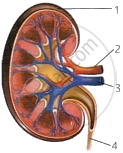
- Label the parts numbered 1 to 4.
- Why does part 2 have a striped appearance?
- What is the fluid that passes down part 4? Name the main nitrogenous waste present in it.
- Mention the structural and functional units of kidneys.
- Name the two major steps in the formation of the fluid mentioned in (c).
Name the basic filtration unit present in the kidney.
State whether the following statement is true or false:
Some organisms store wastes in body parts.
State if the following statement is true or false. Correct the statement if it is false.
Liver produces bile pigments from the hemoglobin of broken RBCs.
Fill in the blank.
Malpighian body consists of Bowman’s capsule and .....................
The following diagram represents a mammalian kidney tubule (nephron) and its blood supply.
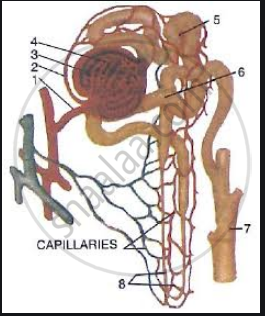
Parts indicated by the guidelines 1to 8 are as follows:
1. Afferent arteriole from renal artery
2. Efferent arteriole
3. Bowman's capsule
4. Glomerulus
5. Proximal convoluted tubule with blood capillaries
6. Distal convoluted tubule with blood capillaries
7. Collecting tubule
8. U-shaped loop of Henle
Study the diagram and answer the question that follow:
Where is most water reabsorbed ?
Write the functional activity of the following structure: Renal artery
Choose the Odd One Out:
The statement given below is false. Rewrite the correct form of the statement by changing the underlined word.
The pigment urochrome is the breakdown product of the haemoglobin of dead RBCs.
