Advertisements
Online Mock Tests
Chapters
1: Cell: The structural and functional unit of life
2: Structure of chromosome, cell cycle and cell division
3: Genetics: Some Basic Fundamentals
Unit-2 : Plant Physiology
4: Absorption by roots: The Processes Involved
5: Transpiration
6: Photosynthesis
7: Chemical Coordination in Plants
Unit-3 : Human Anatomy and Physiology
8: The Circulatory System
▶ 9: The Excretory System
10: The Nervous System
11: Sense Organs
12: The Endocrine System
13: The Reproductive System
Unit-4 : Human Evolution
14: Human Evolution
Unit-5 : Population
15: Population: The increasing numbers and rising problems
Unit-6 : Pollution
16: Pollution: A Rising Environmental Problem
![Selina solutions for Concise Biology [English] Class 10 ICSE chapter 9 - The Excretory System - Shaalaa.com](/images/concise-biology-english-class-10-icse_6:930ad8471f2d4b8b8e0d2fbdad788b1f.jpg "Selina solutions for Concise Biology [English] Class 10 ICSE chapter 9 - The Excretory System")
Advertisements
Solutions for Chapter 9: The Excretory System
Below listed, you can find solutions for Chapter 9 of CISCE Selina for Concise Biology [English] Class 10 ICSE.
Selina solutions for Concise Biology [English] Class 10 ICSE 9 The Excretory System Intext Question [Pages 121 - 126]
Progress Check
Given below is a list of substances - select the ones that need to be eliminated from the body.
Glucose, excess water, amino acids, urea, carbon dioxide, excess common salt, glycogen, uric acid.
Give two examples of the following:
Nitrogenous waste
Give two examples of the following:
Bile pigments
Give two examples of the following:
Main excretory organs
Give two examples of the following:
Accessory excretory organs
Give two examples of the following:
Water-soluble vitamins
Progress Check
Name the following:
The tube arising from the notch of the kidney on the median side and connecting behind with the urinary bladder.
Name the following:
The tube that passes the urine to the outside of the body.
Name the following:
The inner lighter coloured region of the kidney.
Name the following:
Knot-like mass of blood capillary inside Bowman's capsule.
Name the following:
The structural and functional unit of the kidney.
Name the following:
The blood vessel which enters malpighian capsule.
Name the following:
The blood vessel which leaves malpighian capsule.
Given is a jumbled list of the parts of a certain body structure - Loop of Henle, Bowman’s capsule, distal convoluted tubule, glomerulus, proximal convoluted tubule.
- Name the structure to which the listed parts belong.
- Rearrange the parts in their proper sequence from the starting point to where they end.
Progress Check State if the following statements are true or false.
The blood flows through glomerulus under great pressure.
True
False
Mention, if the following statement is True or False. If false rewrite the wrong statement in its correct form:
Glomerular filtrate consists of many substances such as water, salts, glucose and white blood corpuscles.
True
False
Sodium chloride contained in glomerular filtrate is fully reabsorbed in the renal tubule.
True
False
The blood flowing through the renal artery is oxygenated and contains a lot of nitrogenous waste.
True
False
The blood flowing through the renal vein is oxygenated and normally does not contain nitrogenous waste.
True
False
Excessive uric acid may produce kidney stones.
True
False
Selina solutions for Concise Biology [English] Class 10 ICSE 9 The Excretory System Review Questions [Pages 127 - 130]
MULTIPLE CHOICE TYPE (Select the most appropriate option in each case)
The process of removal of unwanted metabolic wastes from the body is called ______.
Eradication
Emission
Excretion
Egestion
The organ that does not belong to the excretory system:
Urethra
Uterus
Ureter
Urinary bladder
The structural and functional unit of the kidney is ______.
villi
liver
nephron
ureter
Neuron
Nerve
Glomerulus
Which of the following is not an example of secretion?
Saliva
Gastric juice
Urine
Milk
The nephrons discharge their urine at ______.
Urinary bladder
Ureter
Renal pelvis
Renal pyramid
An organ that produces urea:
Kidney
Liver
Ureter
Urethra
The main nitrogenous waste formed in the human body:
Uric acid
Ammonia
Urea
Creatinine
The condition in which excess glucose passes with urine is termed as ______.
Glycolysis
Glycogenolysis
Glycogenesis
Glycosuria
The accumulation of high quantities of urea in the human body is termed as ______.
Diuresis
Dialysis
Uremia
Micturition
The process of tubular secretion occurs in ______.
PCT
DPT
DDT
DCT
A biology teacher asked her students to give two examples of organic constituents in the urine that are also nitrogenous wastes produced by the human body.
A said: Urea and Ammonia
B said: Ammonia and Creatinine
C said: Urea and Uric acid
D said: Creatinine and Urea
Who gave the correct response?
A and C
C and D
D and B
B and A
The following questions are Assertion-Reason based questions. Choose the answer from the options given below.
Assertion (A): Kidneys eliminate urea and water only during excretion.
Reason (R): Urea is the most poisonous, nitrogenous waste of the body, so it must be excreted out as early as possible.
- A is True and R is False.
- A is False and R is True.
- Both A and R are True.
- Both A and R are False.
(1)
(2)
(3)
(4)
Assertion (A): Renal artery carries deoxygenated blood full of nitrogenous wastes.
Reason (R): Most of the arteries carry oxygenated blood, but there are exceptions.
- A is True and R is False.
- A is False and R is True.
- Both A and R are True.
- Both A and R are False.
(1)
(2)
(3)
(4)
Assertion (A): Efferent arteriole is wider than the afferent arteriole.
Reason (R): The difference in the size of the diameter of these arterioles creates a high pressure known as hydrostatic pressure. This pressure helps in the process of ultrafiltration through the glomerulus.
- A is True and R is False.
- A is False and R is True.
- Both A and R are True.
- Both A and R are False.
(1)
(2)
(3)
(4)
Assertion (A): Haematuria is the condition in which the blood passes with urine due to some infection in the urinary tract, kidney stones or tumour.
Reason (R): An excessive number of RBCs and haemoglobin is produced in the bone marrow. So these are excreted out through the urine.
- A is True and R is False.
- A is False and R is True.
- Both A and R are True.
- Both A and R are False.
(1)
(2)
(3)
(4)
VERY SHORT ANSWER TYPE
Name the following:
The outer region of kidney containing the Bowman's capsule.
Name the following:
The tuft of capillaries inside the Bowman's capsule.
Name the following:
The part of kidney tubules where the term urine is first used for the fluid in it.
Give Technical Term:
The organ which filters out urea and uric acid from the bloodstream.
Name the following:
The organ through which urea is released outside the body of a human being.
Name the following:
The specific pigment found in urine.
Given below is a set of five terms. Rewrite the terms in their correct order so as to be in logical sequence.
Afferent arteriole, renal vein, secondary capillary network, glomerulus, efferent arteriole.
Given below is a set of five terms. Rewrite the terms in their correct order so as to be in logical sequence.
Renal artery, urethra, ureter, kidney, urinary bladder.
The statement given below is false. Rewrite the correct form of the statement by changing the underlined word.
The outer darker portion of the kidney is termed as medulla.
The statement given below is false. Rewrite the correct form of the statement by changing the underlined word.
The Bowman's capsule and the glomerulus together are called as renal tubule.
The statement given below is false. Rewrite the correct form of the statement by changing the underlined word.
A pair of renal arteries branch off from the vena cava and enter the kidney.
The statement given below is false. Rewrite the correct form of the statement by changing the underlined word.
The glomerular filtrate is collected in Bowman's capsule after the process of reabsorption.
The statement given below is false. Rewrite the correct form of the statement by changing the underlined word.
The pigment urochrome is the breakdown product of the haemoglobin of dead RBCs.
Name the disease caused due to the following abnormal constituent in urine:
Blood
Name the disease caused due to the following abnormal constituent in urine:
Glucose
Name the disease caused due to the following abnormal constituent in urine:
Albumin
Name the disease caused due to the following abnormal constituent in urine:
Bile pigments
SHORT ANSWER TYРЕ
Write the functional activity of the following structure:
Glomerulus
Write down the functional activity of the following parts:
Collecting duct
Write the functional activity of the following structure:
Ureter
Write down the functional activity of the following parts:
Vasa recta
Write the functional activity of the following structure:
Urethra
Match the items in Column I with those in Column II and write down the matching pairs.
| Column I | Column II | ||
| (a) | Bowman's capsule | (i) | Renal artery |
| (b) | Contains more CO2 and less urea | (ii) | Regulates amount of water excreted |
| (c) | Antidiuretic hormone | (iii) | Renal vein |
| (d) | Contains more urea | (iv) | Glomerulus |
Fill in the blanks in the following passage to make it a meaningful description.
In a nephron, the ______ flows through the ______ under great pressure. The reason for this great pressure is that the ______ (outgoing) ______ is narrower than the ______ (incoming). This high pressure causes the ______ part of the blood to filter out from the ______ into the ______ capsule.
Name the following;
Three nitrogenous wastes of our body.
Name the following;
Three organic wastes of our body.
Name the following:
Three inorganic wastes of our body.
Name the following:
Three main parts of our urinary system.
Name the following:
Six main parts of nephron.
Name the following:
Three stages of urine formation.
Name the following:
Three types of fluids in different parts of a nephron.
Choose the odd one out in the following set and write the category for the remaining term:
Kidney, ureter, neuron, urethra, urinary bladder
Choose the odd one out in the following set and write the category for the remaining term:
Ammonia, urea, excess sodium chloride, uric acid
Choose the odd one out in the following set and write the category for the remaining term:
Cortex, medulla, loop of Henle, hilum
Choose the odd one out in the following set and write the category for the remaining term:
Glomerulus, collecting duct, papilla, Bowman's capsule
Write full form of the following abbreviation:
PCT
Write full form of the following abbreviation:
DCT
Write full form of the following abbreviation:
ADH
Write full form of the following abbreviation:
ORS
State the Location:
Kidneys
Write the exact location of the following:
Uriniferous tubule
Write the exact location of the following:
Malpighian capsule
State the exact location of the Loop of Henle.
DESCRIPTIVE TYPE
Define the following:
Excretion
Define the following term:
Kidney
Define the following term:
Micturition
Define the following term:
Osmoregulation
Differentiate between the following pair on the basis of what is indicated in the bracket.
Ureter and Urethra [function]
Differentiate between diabetes mellitus and diabetes insipidus (hormones involved).
Differentiate between Glycosuria and Albuminuria (abnormal constituents).
Differentiate between Diuresis and Uremia (problem).
Differentiate between Malpighian capsule and Loop of Henle (location).
Give reason:
Excretion is a necessary process of our body.
Give reason:
Why does the cortex of kidneys shows a 'dotted' appearance?
Give reason:
We urinate fewer times in summer than in winter and the urine passed is generally thicker.
Give reason:
Why does the medulla of kidneys show a ‘striped’ appearance?
STRUCTURED/APPLICATION/SKILL TYPE
Given below is a simple diagram of the longitudinal section of a human kidney. Study the same and answer the following questions:
 |
- Name the part of kidney which is found between medulla and pelvis.
- What is the basic structural and functional unit of kidney?
- What is main function of kidney?
- Mention the exact location of kidney.
- Write two differences in the composition of blood flowing through blood vessels A and B.
- Name the part of kidney which collects urine for the first time from the nephrons.
- Define 'Osmoregulation'.
- Name the technique which is normally suggested by the doctors to the patients in case of a permanent damage to both the kidneys.
- Name the hormone which is associated with the 'reabsorption' step of urine production.
- Draw a neat and labelled diagram of a malpighian capsule.
Given alongside is the figure of certain organs and associated parts in the human body. Study the same and answer the questions that follow:
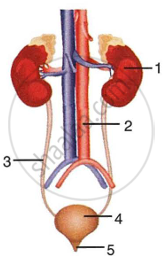 |
- Name all the organ systems shown completely or even 3 partially.
- Name the parts numbered 1 to 5.
- Name the structural and functional unit of the part marked '1'.
- Name the two main organic constituents of the fluid that flows down the part labelled '3'.
- Napie the two major steps involved in the formation of the fluid that passes down the part labelled '3'.
The figure given below represents a kidney tubule in humans and its blood supply. Study the figure and answer the questions that follow. Write specific name and numbers shown in the diagram for each answer.
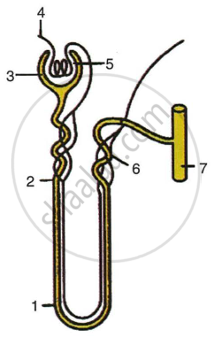 |
- Name the part which consists of a knot - like mass of blood capillaries.
- What is the specific name for the combination of parts shown as 5 and 3?
- Name the part which collects the glomerular filtrate.
- Where is the most water reabsorbed?
- Name the part which collects urine in the diagram shown.
- Which part lies in the medulla of the kidney?
- Which of the above parts is involved in the process of tubular secretion?
- How is hydrostatic pressure created?
- Where does ultrafiltration take place?
- Name two important constituents of urine.
Given below is a simplified diagram of the human kidney cut open longitudinally. Answer the questions that follow.
 |
- Define excretion.
- Why does the cortex of the kidney show a dotted appearance?
- Why does the medulla of the kidney show a striped appearance?
- Write two differences in the composition of the blood flowing through the blood vessels 'A' and 'B'.
Study the diagram given below and then answer the questions that follow:
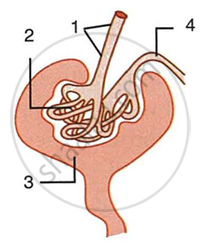 |
- Name the region in the kidney where the above structure is present?
- Name the parts labelled 1, 2, 3 and 4.
- Name the stages involved in the formation of urine.
- What is the technical term given to the process occurring in 2 and 3? Briefly describe the process.
Solutions for 9: The Excretory System
Selina solutions for Concise Biology [English] Class 10 ICSE chapter 9 - The Excretory System
Shaalaa.com has the CISCE Mathematics Concise Biology [English] Class 10 ICSE CISCE solutions in a manner that help students grasp basic concepts better and faster. The detailed, step-by-step solutions will help you understand the concepts better and clarify any confusion. Selina solutions for Mathematics Concise Biology [English] Class 10 ICSE CISCE 9 (The Excretory System) include all questions with answers and detailed explanations. This will clear students' doubts about questions and improve their application skills while preparing for board exams.
Further, we at Shaalaa.com provide such solutions so students can prepare for written exams. Selina textbook solutions can be a core help for self-study and provide excellent self-help guidance for students.
Concepts covered in Concise Biology [English] Class 10 ICSE chapter 9 The Excretory System are Structure of a Kidney Tubule (Nephrons), Kidney and Its Internal Structure, Excretion, Function of the Kidney - “Production of Urine”, Urine, Osmoregulation, Dialysis and Artificial Kidney, Afferent Arteriole Vs Efferent Arteriole, The Excretory Organs, Structure of a Kidney Tubule (Nephrons), Kidney and Its Internal Structure, Excretion, Function of the Kidney - “Production of Urine”, Urine, Osmoregulation, Dialysis and Artificial Kidney, Afferent Arteriole Vs Efferent Arteriole, The Excretory Organs, Structure of a Kidney Tubule (Nephrons), Kidney and Its Internal Structure, Excretion, Function of the Kidney - “Production of Urine”, Urine, Osmoregulation, Dialysis and Artificial Kidney, Afferent Arteriole Vs Efferent Arteriole, The Excretory Organs.
Using Selina Concise Biology [English] Class 10 ICSE solutions The Excretory System exercise by students is an easy way to prepare for the exams, as they involve solutions arranged chapter-wise and also page-wise. The questions involved in Selina Solutions are essential questions that can be asked in the final exam. Maximum CISCE Concise Biology [English] Class 10 ICSE students prefer Selina Textbook Solutions to score more in exams.
Get the free view of Chapter 9, The Excretory System Concise Biology [English] Class 10 ICSE additional questions for Mathematics Concise Biology [English] Class 10 ICSE CISCE, and you can use Shaalaa.com to keep it handy for your exam preparation.
