Advertisements
Advertisements
Question
Given below is a list of substances - select the ones that need to be eliminated from the body.
Glucose, excess water, amino acids, urea, carbon dioxide, excess common salt, glycogen, uric acid.
Advertisements
Solution
Excess water, urea, carbon dioxide, excess common salt, uric acid.
APPEARS IN
RELATED QUESTIONS
Give biological reasons for the following statements: There is frequent urination in winter than in summer
Name an animal which absorbs oxygen through its moist skin.
What do kidneys excrete?
Differentiate between
excretion and transpiration
One of the following sets of body parts or substances or processed, pick out the one item which overall includes the remaining foir.
Skin, liver, lungs, kidneys, excretion.
Given below is a highly simplified diagram of the human kidney cut open longitudinally. Answer the question that follow:
Name the functional units of the kidneys.
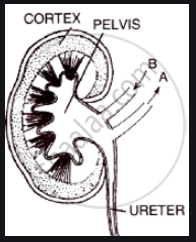
Name the Following
The division of the kidney which is light in colour and subdivided into conical renal pyramids.
Name the Following
The substance found in excess in the urine of a diabetic patient.
Give Technical Term:
The organ in man concerned with maintaining water balance in the body.
Write the functional activity of the following structure: Renal artery
