Advertisements
Advertisements
Question
The figure given below represents a kidney tubule in humans and its blood supply. Study the figure and answer the questions that follow. Write specific name and numbers shown in the diagram for each answer.
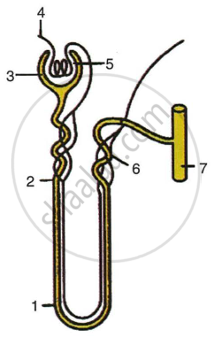 |
- Name the part which consists of a knot - like mass of blood capillaries.
- What is the specific name for the combination of parts shown as 5 and 3?
- Name the part which collects the glomerular filtrate.
- Where is the most water reabsorbed?
- Name the part which collects urine in the diagram shown.
- Which part lies in the medulla of the kidney?
- Which of the above parts is involved in the process of tubular secretion?
- How is hydrostatic pressure created?
- Where does ultrafiltration take place?
- Name two important constituents of urine.
Advertisements
Solution
- Glomerulus
- Malpighian capsule
- Bowman's Capsule
- Proximal Convoluted Tubule
- Collecting Duct
- Loop of Henle and Collecting Duct
- Proximal and Distal Convoluted tubule
- The efferent (outgoing) arteriole is thinner than the afferent (incoming). This creates significant hydrostatic pressure in the glomerulus.
- Glomerulus
- Components of urine are water and solid waste (urea, creatinine, uric acid, etc.)
APPEARS IN
RELATED QUESTIONS
State whether true or false. If false, correct the statement.
Glomerular filtrate consists of many substances like amino acids, vitamins, hormones, salts, glucose and other essential substances.
Explain the structure of kidney and the steps involved in the formation of urine
Which of the following is/are part(s) of the tubular part of the nephron?
Glucose is reabsorbed from the glomerular filtrate mainly in the ____________.
Identify the CORRECT combinations in the given table.
| Part of nephron | Location | Function | |
| i. | Malpighian body | Cortex | Filtering blood |
| ii. | Proximal convoluted tubule | Cortex | Absorption of useful substances |
| iii. | Distal convoluted tubule | Only Medulla | Absorption of urea by action of ADH |
| iv. | Collecting duct | Either Cortex or Medulla | Collection of urine |
What would be the outcome if the PCT is removed from the nephron?
A nephron consists of ______
The blood flowing through the renal vein is oxygenated and normally does not contain nitrogenous waste.
Name the following:
Six main parts of nephron.
Assertion A: Nephrons are of two types: Cortical & Juxta medullary, based on their relative position in cortex and medulla.
Reason R: Juxta medullary nephrons have short loop of Henle whereas, cortical nephrons have longer loop of Henle.
In the light of the above statements, choose the correct answer from the options given below:
