Advertisements
Advertisements
Question
The blood flowing through the renal vein is oxygenated and normally does not contain nitrogenous waste.
Options
True
False
Advertisements
Solution
This statement is False.
Explanation:
The blood flowing through the renal vein is deoxygenated and normally contains nitrogenous waste.
APPEARS IN
RELATED QUESTIONS
Assertion: Urea is excreted out through the kidneys.
Reason: Urea is a toxic substance.
Identify the CORRECT combinations in the given table.
| Part of nephron | Location | Function | |
| i. | Malpighian body | Cortex | Filtering blood |
| ii. | Proximal convoluted tubule | Cortex | Absorption of useful substances |
| iii. | Distal convoluted tubule | Only Medulla | Absorption of urea by action of ADH |
| iv. | Collecting duct | Either Cortex or Medulla | Collection of urine |
The loop of Henle and collecting ducts lie in the ____________ of the kidney.
A nephron consists of ______
JG cells of Kidney secrete ______.
Name the following:
Six main parts of nephron.
Name the following:
Three types of fluids in different parts of a nephron.
Choose the odd one out in the following set and write the category for the remaining term:
Cortex, medulla, loop of Henle, hilum
Choose the odd one out in the following set and write the category for the remaining term:
Glomerulus, collecting duct, papilla, Bowman's capsule
The figure given below represents a kidney tubule in humans and its blood supply. Study the figure and answer the questions that follow. Write specific name and numbers shown in the diagram for each answer.
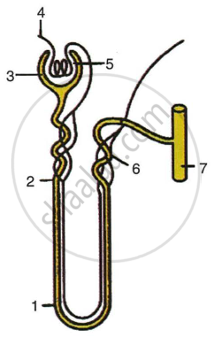 |
- Name the part which consists of a knot - like mass of blood capillaries.
- What is the specific name for the combination of parts shown as 5 and 3?
- Name the part which collects the glomerular filtrate.
- Where is the most water reabsorbed?
- Name the part which collects urine in the diagram shown.
- Which part lies in the medulla of the kidney?
- Which of the above parts is involved in the process of tubular secretion?
- How is hydrostatic pressure created?
- Where does ultrafiltration take place?
- Name two important constituents of urine.
