A dialysis machine contains long tubes coiled in a tank containing dialysing solution: Name the main waste which passes into the dialysing solution.
Advertisements
प्रश्न
A dialysis machine contains long tubes coiled in a tank containing dialysing solution:
Name the main waste which passes into the dialysing solution.
Advertisements
उत्तर
The main waste that passes into the dialysing solution is urea.
APPEARS IN
संबंधित प्रश्न
Why is it necessary to excrete waste products?
The given diagram represents a nephron and its blood supply. Study the diagram and answer the following questions:

(i) Label parts 1, 2, 3 and 4.
(ii) State the reason for the high hydrostatic pressure in the glomerulus.
(iii) Name the blood vessel which contains the least amount of urea in this diagram.
(iv) Name the two main stages of urine formation.
(v) Name the part of the nephron which lies in the renal medulla.
Draw a neat labelled diagram of the human excretory system.
Put a tick mark (✓) against the most appropriate alternative in the following statement :
In human beings, urea is produced in :
Name the following:
The part of kidney tubules where the term urine is first used for the fluid in it.
Given below is a simplified diagram of the human kidney cut open longitudinally. Answer the questions that follow.
 |
- Define excretion.
- Why does the cortex of the kidney show a dotted appearance?
- Why does the medulla of the kidney show a striped appearance?
- Write two differences in the composition of the blood flowing through the blood vessels 'A' and 'B'.
Choose the correct answer:
The smallest functional unit of the kidney is ____________
The following diagram represents a mammalian kidney tubule (nephron) and its blood supply.
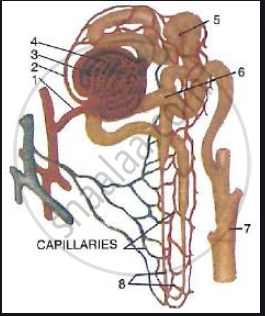
Parts indicated by the guidelines 1to 8 are as follows:
1. Afferent arteriole from renal artery
2. Efferent arteriole
3. Bowman's capsule
4. Glomerulus
5. Proximal convoluted tubule with blood capillaries
6. Distal convoluted tubule with blood capillaries
7. Collecting tubule
8. U-shaped loop of Henle
Study the diagram and answer the question that follow:
Which structure contains the lowest concentration of urea?
The following diagram represents a mammalian kidney tubule (nephron) and its blood supply.
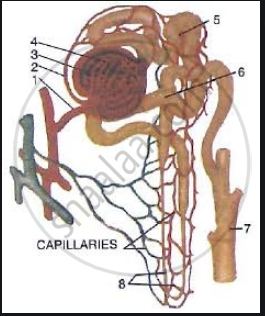
Parts indicated by the guidelines 1to 8 are as follows:
1. Afferent arteriole from renal artery
2. Efferent arteriole
3. Bowman's capsule
4. Glomerulus
5. Proximal convoluted tubule with blood capillaries
6. Distal convoluted tubule with blood capillaries
7. Collecting tubule
8. U-shaped loop of Henle
Study the diagram and answer the question that follow:
Which structure contains the highest concentration of urea?
Explain the functioning of kidney.
Given below is a simple diagram of the human kidney cut open longitudinally. Answer the following questions: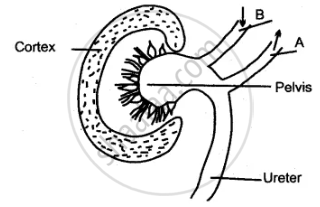
c
(v) Write two differences in the composition of the blood flowing through blood vessels A and B.
Name the Following
The branch of renal artery which enters into Bowman’s capsule.
Write the functional activity of the following structure: Aldosterone
Choose the Odd One Out:
The product of the process of deamination is ______.
The process of diffusion of solvent particles from the region of less solute concentration to a region of high solute concentration through a semi-permeable membrane is known as ____________.
Given below is a list of substances - select the ones that need to be eliminated from the body.
Glucose, excess water, amino acids, urea, carbon dioxide, excess common salt, glycogen, uric acid.
Give two examples of the following:
Bile pigments
Salt excreting glands are found near ______ in marine birds like Albatross.
