Advertisements
Advertisements
प्रश्न
Given below is a simple diagram of the human kidney cut open longitudinally. Answer the following questions: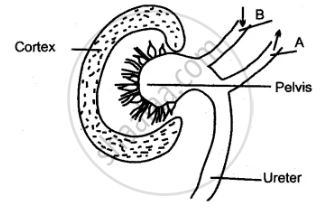
c
(v) Write two differences in the composition of the blood flowing through blood vessels A and B.
Advertisements
उत्तर
(i) Excretion is the process of removal of all harmful and unwanted products especially nitrogenous products from the body of living beings.
(ii) The units of the kidney are nephrons.
(iii) The dotted cortex of kidney shows the presence of nephrons (Bowman’s Capsule) in this region.
(iv) Two functions of kidney are:
(a) It expels out all the nitrogenous products produced in the body.
(b) It helps in osmoregulation.
(v) Two differences in the composition of blood flowing through blood vessels A and B are:
(a) A contains blood having a large amount of water and nitrogenous wastes while blood in B is thicker and free from toxic substances.
(b) B carries more O2 and nitrogenous waste products as it is Renal Artery. A carries CO2 and no nitrogenous products.
APPEARS IN
संबंधित प्रश्न
Why is it necessary to excrete waste products?
Write the functions of the Urinary bladder
Explain the principle of dialysis with the help of a labelled diagram.
Write down the functional activity of the following parts,
Renal artery ………………
Choose the odd one out in the following serie:
Column of Bertini, minora calyces, brain.
Draw a labeled diagram of the human kidney as seen in a longitudinal section.
Give Technical Term:
The tube joining the kidney to the urinary bladder.
Write the functional activity of the following structure: Aldosterone
Write the functional activity of the following structure: Kidney
What is the purpose of making urine in the human body?
