Advertisements
Advertisements
प्रश्न
Given below is a simple diagram of the human kidney cut open longitudinally. Answer the following questions: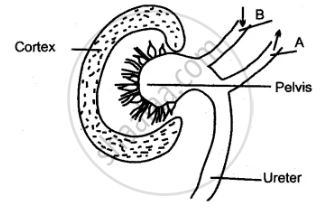
c
(v) Write two differences in the composition of the blood flowing through blood vessels A and B.
Advertisements
उत्तर
(i) Excretion is the process of removal of all harmful and unwanted products especially nitrogenous products from the body of living beings.
(ii) The units of the kidney are nephrons.
(iii) The dotted cortex of kidney shows the presence of nephrons (Bowman’s Capsule) in this region.
(iv) Two functions of kidney are:
(a) It expels out all the nitrogenous products produced in the body.
(b) It helps in osmoregulation.
(v) Two differences in the composition of blood flowing through blood vessels A and B are:
(a) A contains blood having a large amount of water and nitrogenous wastes while blood in B is thicker and free from toxic substances.
(b) B carries more O2 and nitrogenous waste products as it is Renal Artery. A carries CO2 and no nitrogenous products.
APPEARS IN
संबंधित प्रश्न
Blood in the renal artery or renal vein (Which one has more urea?)
With which human organ system (or human systems) is the glomerulus associated?
Why is it necessary to maintain a normal osmotic concentration of the blood?
Explain in your own words with suitable examples.
How does excretion occur in human beings?
Draw a labeled diagram of the human kidney as seen in a longitudinal section.
Name the Following
The branch of renal artery which enters into Bowman’s capsule.
Choose the Odd One Out:
Choose the correct option.
Which one of the following organisms would spend maximum energy in the production of nitrogenous waste?
Why is the rate of breathing in aquatic organisms much faster than in terrestrial organisms?
An organ that produces urea:
