Advertisements
Advertisements
प्रश्न
Name the Following
The branch of renal artery which enters into Bowman’s capsule.
Advertisements
उत्तर
Afferent arteriole
APPEARS IN
संबंधित प्रश्न
Explain Selective reabsorption
Write the functions of Ureter.
Differentiate between
excretion and transpiration
Choose the correct answer:
Narrow apex of pyramid in kidney is called ___________
Study the diagram given alongside and then answer the question that follow:
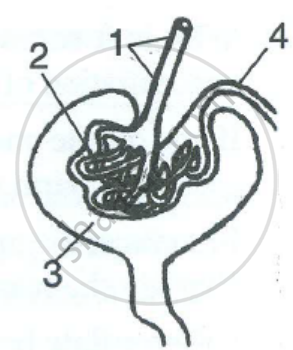
Name the stages involved in the formation of urine.
The diagram below represents a mammalian kidney tubule (nephron) and its blood supply. Parts indicated by the guidelines 1 to 8 are as follows:
1. U-shaped loop of Henle
2. Proximal convoluted tubule with blood capillaries
3. Bowman’s capsule
4. Afferent arteriole from the renal artery
5. Glomerulus
6. Venule to the renal vein
7. Collecting tubule
8. Distal convoluted tubule with blood capillaries Study the diagram and answer the following questions in each case:
(i) Where does ultrafiltration take place?
(ii) Which structure contains the lowest concentration of urea?
(iii) Which structure contains the highest concentration of urea?
(iv) Which structure contains the lowest concentration of glucose?
(v) Where is the most water reabsorbed?
Give Technical Term:
The organ in man concerned with maintaining water balance in the body.
Complete the following sentence with appropriate word:
Human kidney is made up of ______.
Why is the rate of breathing in aquatic organisms much faster than in terrestrial organisms?
The process of removal of unwanted metabolic wastes from the body is called ______.
