Advertisements
Advertisements
प्रश्न
Fill in the blank.
.................. produces bile pigments from the heamoglobin of broken RBCs.
Advertisements
उत्तर
Liver produces bile pigments from the haemoglobin of broken RBCs.
APPEARS IN
संबंधित प्रश्न
The diagram given alongside shows a section of a human kidney. Study the diagram carefully and answer the questions that follow:
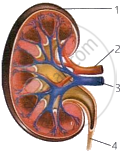
- Label the parts numbered 1 to 4.
- Why does part 2 have a striped appearance?
- What is the fluid that passes down part 4? Name the main nitrogenous waste present in it.
- Mention the structural and functional units of kidneys.
- Name the two major steps in the formation of the fluid mentioned in (c).
Why do some people need to use a dialysis machine? What does the machine do?
Answer the following in short.
What is excretion?
Why is it necessary to maintain a normal osmotic concentration of the blood?
Correct and rewrite the statement by changing the biological term that is underlined for the statement:
The kidney is composed of number of neurons.
Choose the Odd One Out:
Choose the correct option.
Which one of the following organisms would spend maximum energy in the production of nitrogenous waste?
The number of ATP molecules required to produce one molecule of urea from the omithine cycle.
“All plants give out oxygen during the day and carbon dioxide during the night”. Do you agree with this statement? Give a reason.
Choose the odd one out in the following set and write the category for the remaining term:
Ammonia, urea, excess sodium chloride, uric acid
