Advertisements
Advertisements
प्रश्न
The diagram given alongside is that of a structure present in a human kidney:
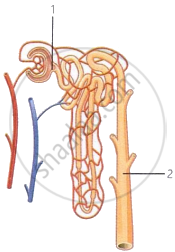
Study the same and answer the questions that follow:
- Name the structure represented in the diagram.
- What is the liquid entering part ‘1’ called?
Name two substances present in this liquid that are reabsorbed in the tubule - What is the fluid that comes to part ‘2’ called? Name the main nitrogenous waste in it.
- Mention the three main steps involved in the formation of the fluid mentioned in (c) above.
- Name the substance which may be present in the fluid in part ‘2’ if a person suffers from Diabetes mellitus
Advertisements
उत्तर
- Nephron
- The liquid entering part 1 is called glomerular filtrate, which is formed by the ultrafiltration of blood through the glomerulus. The two substances present in this liquid are glucose and water.
- The fluid that comes to part 2 is called urine. The main nitrogenous waste in urine is urea.
- The three main steps involved in the formation of urine are:
- Ultrafiltration
- Selective reabsorption
- Tubular secretion
- Glucose
संबंधित प्रश्न
Describe the structure of nephrons.
The nephrons discharge their urine at ______.
Give the biological/technical terms for the following:
The hormone increasing reabsorption of water by kidney tubules.
Define excretion.
Differentiate between the following pairs of term :
Renal cortex and renal medulla
Choose the correct answer:
Narrow apex of pyramid in kidney is called ___________
Give Technical Terms
The hormone that helps increase the reabsorption of water from the kidney tubules.
Complete the following sentence with appropriate word:
Besides excretion, the kidneys also carry out the important function of ______.
Write the functional activity of the following structure: Nephron
Osmoregulation maintains the osmolarity of blood at about ______.
