The diagram given alongside represents an organ system in the human body. Study the same and answer the questions that follow: (a) Identify the system (b) Label the parts marked 2 and 4. Mention the
Advertisements
प्रश्न
The diagram given alongside represents an organ system in the human body. Study the same and answer the questions that follow:
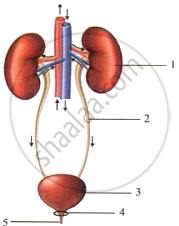
- Identify the system
- Label the parts marked 2 and 4. Mention the function of part 5.
- Name the structural and functional units of the part marked 1.
- What is the fluid that accumulates in part 3?
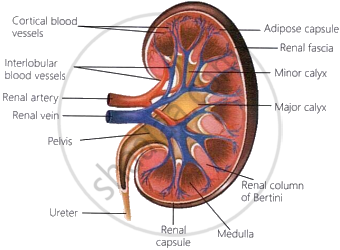
Which is the main nitrogenous waste present in it? - Draw a neat, labelled diagram showing the longitudinal section of part 1.
Advertisements
उत्तर
- The diagram shows the urinary (excretory) system.
- 2: Ureter
4: Sphincter muscle
Part 5 is the urethra. Its function is to expel urine from the urinary bladder to the outside of the body during urination (micturition). - The structural and functional units of the kidneys are nephrons.
- Fluid that accumulates is urine. The main nitrogenous waste present in it is urea.
संबंधित प्रश्न
Define excretion. Write the four organs of the human urinary system in their correct sequence.
Answer the following in short.
What are the main organs involved in the human excretory system?
One of Harry’s organs is not functioning properly. There is extra fluid build up in his body causing swelling in his ankles and feet.
What should Harry do? Tick the correct answer.
Which of Harry’s organs is not working properly?
Given alongside is the figure of certain organs and associated parts in the human body. Study the same and answer the questions that follow:
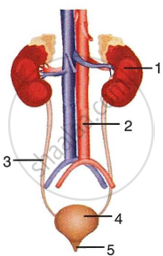 |
- Name all the organ systems shown completely or even 3 partially.
- Name the parts numbered 1 to 5.
- Name the structural and functional unit of the part marked '1'.
- Name the two main organic constituents of the fluid that flows down the part labelled '3'.
- Napie the two major steps involved in the formation of the fluid that passes down the part labelled '3'.
Draw and label the diagram.
Nephron
Give Reasons for the Following:
All living things must excrete.
How many kidneys do we have?
The Malpighian corpuscle lies in the______ of the kidney.
The endocrine nature of the kidney is indicated by the secretion of ______
We can produce a concentrated/ dilute urine. This is facilitated by a special mechanism. Identify the mechanism.
