Advertisements
Advertisements
प्रश्न
We can produce a concentrated/ dilute urine. This is facilitated by a special mechanism. Identify the mechanism.
पर्याय
Reabsorption from PCT
Reabsorption from Collecting Duct
Reabsorption/Secretion in DCT
Counter current mechanism in Henle’s loop/Vasa recta
Advertisements
उत्तर
Counter current mechanism in Henle’s loop/Vasa recta
Explanation:
Counter current mechanism operates between the two limbs of the loop of Henle and those of vasa recta. The filtrate becomes concentrated when it moves down the descending limb but is diluted by the ascending limb.
APPEARS IN
संबंधित प्रश्न
State if the following statement is true or false. Correct the statement if it is false.
The organs that help our body to get rid of the waste are called respiratory organs.
Answer the following in detail.
How do skin and lungs help in excretion?
One of Harry’s organs is not functioning properly. There is extra fluid build up in his body causing swelling in his ankles and feet.
What should Harry do? Tick the correct answer.
He should see a
Match the terms in Column I with those in Column II and write down the matching pairs
| Column I | Column II | |
| a | Bowman's Capsule | Renal artery |
| b | Contains more CO2 and less urea | Regulates amount of water excreted |
| c | Anti-diuretic hormone | Renal Vein |
| d | Contains more urea | Glomerulus |
The diagram given below represents an organ system in the human body. Study the same and answer the questions that follow :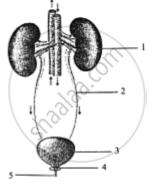
Label the parts marked 2 and 4. Mention the function of part 5.
Choose the correct answer:
Presence of RBCs in urine is called _____________
Choose the odd one out in the following series:
Glomerulus, alveoli, bronchi.
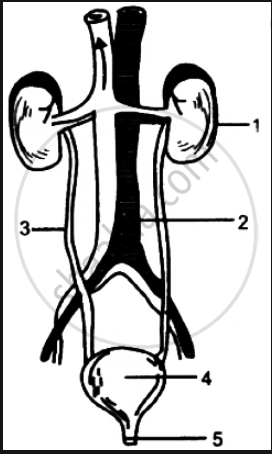
Given below is the figure of certain organs and associated parts in the human body. Study the same and answer the question that follow:
Name the two main organic constituents of the fluid that flows down the part labeled '3'.
Why is urine yellow in colour ?
Describe about physical properties of urine
Draw a well-labeled diagram of the human excretory system.
Explain the Term: Urinary bladder
State the Location:
Kidneys
Multiple Choice Question: Excretion commonly involves
Column 2 is a list of items related to ideas in Column 1. Match the term in Column 2 with the suitable idea given in Column 1.
| Column 1 | Column 2 | ||
| i | Liver | a | basic unit of the brain |
| ii | Ova | b | stimulated by light |
| iii | Alveoli | c | deoxygenated blood |
| iv | Cochlea | d | part of the sclera |
| v | Vein | e | haploid cell |
| vi | Neuron | f | blind sacs |
| vii | Stomata | g | found in the kidney |
| viii | Grana | h | audio receptors |
| i | diffusion of gases | ||
| j | breakdown of proteins | ||
| k | diploid cell | ||
Choose the correct option.
Bowman’s capsule is located in kidney in the _______.
The left side of the heart receives oxygenated blood from ______.
Which blood vessel has largest amount of urea?
Define the following term:
Kidney
