Advertisements
Advertisements
प्रश्न
Draw and label the diagram.
Nephron
Draw a well-labelled diagram of nephron and label atleast 4 of its parts.
Advertisements
उत्तर
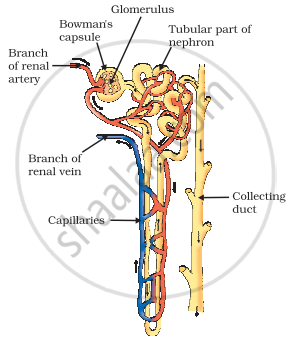
Notes
Students should refer to the answer according to their questions.
संबंधित प्रश्न
Maximum amount of water from the glomerular filtrate is reabsorbed in
Name the following:
Organ which stores urine.
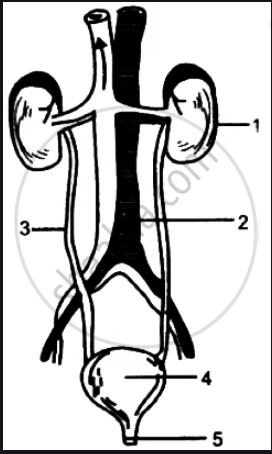
Given below is the figure of certain organs and associated parts in the human body. Study the same and answer the question that follow:
Name the structural and functional unit of the part marked '1'.
With the help of a labelled diagram describe human excretory system.
How will you identify acute kidney injury by urine analysis?
Give a simple definition of excretion.
Think of the following: Tears, sweat, saliva, milk, Insulin, urine.
What are these excretion or secretion ? Why ?
What is osmoregulation?
Give Technical Term:
The nitrogenous wastes produced in man.
Give Technical Term:
The waste product which is excreted by the liver.
Complete the following sentence with appropriate word:
The process of releasing urine is ______.
Write the functional activity of the following structure: Urethra
Choose the Odd One Out:
Multiple Choice Question: Urea is synthesized from extra amino acids in:
Choose the correct option.
Volume of the urine is regulated by ______.
The glomerular capillaries filter out its contents due to ____________.
What is the contribution of Joseph E. Murray to Nephrology?
Match the terms given in Column I with their physiological processes given in Column II and choose the correct answer
| Column I | Column II |
| A. Proximal convoluted tubule | i. Formation of concentrated urine |
| B. Distal convoluted tubule | ii. Filtration of blood |
| C. Henle's loop | iii. Reabsorption of 70 - 80% of electrolytes |
| D. Counter-current mechanism | iv. Ionic balance |
| E. Renal corpuscle | v. Maintenance of concentration gradient in medulla |
The maximum amount of electrolytes and water (70-80%) from the glomerular filtrate is reabsorbed in which part of the nephron.
Sodium chloride contained in glomerular filtrate is fully reabsorbed in the renal tubule.
