Advertisements
Advertisements
प्रश्न
Draw and label the diagram.
Nephron
Draw a well-labelled diagram of nephron and label atleast 4 of its parts.
Advertisements
उत्तर
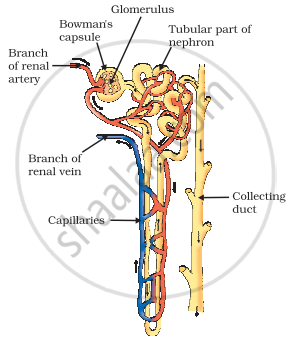
Notes
Students should refer to the answer according to their questions.
संबंधित प्रश्न
State if the following statement is true or false. Correct the statement if it is false.
The organs that help our body to get rid of the waste are called respiratory organs.
Fill in the blank.
.................. carries urine from the kidney to the urinary bladder.
Answer the following in short.
What is urethra?
One of Harry’s organs is not functioning properly. There is extra fluid build up in his body causing swelling in his ankles and feet.
What should Harry do? Tick the correct answer.
He should see a
Choose the correct answer:
Physiologically urea is produced by the action of an enzyme ______________
What is osmoregulation?
Explain the Term: Malpighian body
Give Technical Term:
The waste product which is excreted by the liver.
Give Technical Terms:
What are the organic constituents of normal human urine?
Choose the Odd One Out:
Multiple Choice Question: What is the chief nitrogenous waste in mammals?
The functional unit of kidney is ______.
Identify the biological term
Removal of unwanted substances from the body.
Urethra is a passage from which urine is ____________.
Arrange the following statements in the correct order in which they occur during the formation and removal of urine in human beings.
- Ureters carry urine to the urinary bladder.
- Wastes dissolved in water are filtered out as urine in the kidneys.
- Urine stored in the urinary bladder is passed out through the urinary opening at the end of the urethra.
- Blood containing useful and harmful substances reaches the kidneys for filtration.
- Useful substances are absorbed back into the blood.
Rearrange the jumbled words and fill in the blanks in the following passage to make it a meaningful description.
The human urinary system consists of a pair of ______ ( nyedik), which form the urine; a pair of ______ (ertreu), which conduct the ______ (neuri) from kidneys to the ______ (naryuri drebdal) for storage of urine and a ______ (reuhrat) through which the urine is voided by bladder contractions.
In between the two adjacent renal pyramids, ..A ... is present. Identify A
Arrange and rewrite the terms in group in correct order to be in a logical sequence, beginning with the term that is underlined:
Loop of Henle, Distal convoluted tubule, Bowman's Capsule, Proximal convoluted tubule.
The double walls of Bowman’s capsule are composed of ______ epithelium.
