- The kidneys are two bean-shaped organs located on either side of the vertebral column, at the back of the abdomen. Each kidney contains about 1 million tiny filtering units called nephrons.
- A nephron has a thin-walled Bowman’s capsule and a capillary network called the glomerulus.
- Urea, produced in the liver, enters the blood and is filtered out in the glomerulus along with other waste substances.
- Water and small useful molecules pass through the semipermeable membrane of the Bowman’s capsule and enter the nephron’s tubular part.
- Useful substances like water, glucose, and salts are reabsorbed into the blood from the nephron tubules.
- The remaining waste solution becomes urine, which is carried to the urinary bladder by the ureters.
- The urinary bladder stores urine and expels it through the urethra when it contracts, under nerve control.
- The kidneys filter about 190 litres of blood daily, forming 1 to 1.9 litres of urine, while the rest of the liquid is reabsorbed. The right kidney is slightly lower than the left.
- Skin and lungs also assist in excretion by removing sweat and carbon dioxide, respectively. The kidneys filter the body’s 5 litres of blood about 400 times each day.
Topics
Living World
- Concept of Living
- Taxonomical Aids
Systematics of Living Organisms
- Systematics of Living Organisms (Introduction)
- Systematics of Living Organisms (Introduction)
- Concept of Systematics
- Concept of Systematics
- Classification of Taxonomy
- Classification of Taxonomy
- Three Domains of Life
- Three Domains of Life
- Chemotaxonomy
- Chemotaxonomy
- Numerical Taxonomy
- Numerical Taxonomy
- Cladogram
- Cladogram
- Phylogeny
- Phylogeny
- DNA Barcoding
- DNA Barcoding
- Taxonomic Hierarchy of Living Organisms: Unit of Classification
- Taxonomic Hierarchy of Living Organisms: Unit of Classification
- Taxonomic Hierarchy
- Taxonomic Hierarchy
- Units of Classification
- Units of Classification
- Binomial Nomenclature
- General Features of Five Kingdoms
- General Features of Five Kingdoms
- Acellular Organisms
- Acellular Organisms
Kingdom Plantae
- Kingdom Plantae
- Salient Features of Major Plant Groups Under Cryptogams
- Salient Features of Major Plant Groups Under Phanerogams
- Plant Life Cycle and Alternation of Generations
Kingdom Animalia
- Criteria Used for Animal Classification
- Animal Body Plan
- History of Animal Classification
Cell Structure and Organization
- Cell: Structural and Functional Unit of Life
- Types of Cells
- Components of Eukaryotic Cell
Biomolecules
- Biomolecules in Living System
- Biomolecules in the Cell
- Biomolecules in the Cell > Carbohydrates
- Biomolecules in the Cell > Lipids
- Biomolecules in the Cell > Proteins
- Biomolecules in the Cell > Nucleic Acids
- Biomolecules in the Cell > Enzymes
- Nature of Enzyme Action
- Biomolecules in the Cell > Enzymes
- Biomolecules in the Cell > Enzymes
- Enzyme - Substrate Interactions
- Factors Affecting Enzyme Activity
- Metabolism
- Metabolic Pool
- Metabolism
Cell Division
Plant Tissues and Anatomy
- Tissues - “The Teams of Workers”
- Meristems or Meristematic Tissues
- Permanent Tissue
- Tissue System
- Secondary Growth in Plants
- Wood
- Cork Cambium and Secondary Growth
- Anatomy of Root, Stem and Leaf
Morphology of Flowering Plants
- Phanerogams > Division II- Angiosperms
- Evidences of organic evolution > Morphology
- Study of Some Important Families
Animal Tissue
Study of Animal Type : Cockroach
- Systematic Position
- External Morphology
- Criteria for New System of Classification > Body Cavity (Coelom)
- Digestive System of Cockroach
- Reproduction System
- Interactions with Mankind
Photosynthesis
- Concept of Photosynthesis
- Chloroplasts
- Nature of Light
- Mechanism of Photosynthesis
- Light Reaction
- Photophosphorylation
- Light-Independent Phase of Photosynthesis
- Photorespiration
- C4 Pathway Or Hatch-slack Pathway
- Cam - Crassulacean Acid Metabolism
- Factors Affecting Photosynthesis
Respiration and Energy Transfer
- Production of ATP
- Glycolysis
- Phases of Respiration: Pyruvate Oxidation (Link Reaction)
- Electron Transport System (Ets) and Oxidative Phosphorylation
- Tricarboxylic Acid Cycle (Citric Acid Cycle or Kreb’s Cycle)
- Phases of Respiration: Electron Transport Chain (Electron Transfer System)
- Fermentation
- Respiratory Balance Sheet
- Amphibolic Pathways
- Utility of Stepwise Oxidation
- Respiratory Quotient
Human Nutrition
- Nutrients and Nutrition
- Component of Food
- Human Digestive System
- The Mouth and Buccal Cavity
- The Salivary Glands
- The Teeth and Its Structure
- Human Digestive System
- The Food Pipe/Oesophagus
- The Stomach
- The Small Intestine
- The Large Intestine
- Human Digestive System
- Physiology of Digestion
- Absorption of Food
- Assimilation of Food
- Egestion of Food
- Nutritional and Digestive Tract Disorders
Excretion and Osmoregulation
- Excretion
- Modes of Excretion: Ammonotelism, Ureotelism, and Uricotelism
- Human Excretory System
- Kidney and Its Internal Structure
- Structure of a Kidney Tubule (Nephrons)
- Function of the Kidney - “Production of Urine”
- Concentration of Urine
- Composition of Urine
- The Excretory Organs
- Common Disorders of the Urinary System
Skeleton and Movement
- Movements and Locomotion
- Location and Structure of Skeletal Muscles
- Working of Skeletal Muscles
- Mechanism of Muscle Contraction
- Physiology of Muscle Relaxation
- Relaxation of Muscle Fibres
- Skeletal System
- Group of Skeleton
- Types of Joints
- Disorders Related to Muscles
- Disorders Related to Bones
Estimated time: 32 minutes
- Introduction
- Human Excretory System Organs
- Excretion in Humans
- Mechanism of Excretion in Humans
- Dialysis
Maharashtra State Board: Class 5
Introduction:
Our bodies get nutrients from the food we eat, which is digested and used to give us energy and keep us healthy. However, during this process, the body produces some harmful or toxic substances as waste. To stay healthy, the body needs to get rid of these wastes, and this is done through a process called excretion.
- Excretion is important because it removes these harmful wastes, keeping the body clean and functioning properly.
- Different living things have their own ways of getting rid of waste, depending on where they live and what they eat. For example, some use their kidneys, lungs, skin, or even eyes to remove waste.
- In humans, the kidneys are the main organs responsible for filtering the blood and removing waste. This waste is then sent out of the body in the form of urine.
- Other organs, like the lungs (which remove carbon dioxide when we breathe out), skin (which releases sweat) and eyes (which remove waste through tears), also help in the excretion process. All of these systems work together to keep the body healthy.
Maharashtra State Board: Class 9
Human Excretory System Organs:
1. Kidneys: Bean-shaped organs located on either side of the backbone. They filter blood and remove waste, producing urine. Each kidney is about 10-12 cm long and weighs around 120-170 g.
Structure of the Kidney:
- Capsule: The outer protective layer of the kidney.
- Cortex and Medulla: Two zones inside the kidney.
- Cortex: The outer region.
- Medulla: The inner region containing the loops of Henle.
- Nephrons: The functional units of the kidney that filter blood and make urine.
- Glomerulus: A bunch of capillaries that filter blood.
- Bowman’s capsule: A cup-shaped structure around the glomerulus.
- Henle’s loop: Part of the nephron that helps concentrate urine.
2. Ureters: A pair of thin tubes that carry urine from the kidneys to the bladder.
3. Urinary Bladder: A muscular sac that stores urine until it is ready to be excreted. When full, the bladder empties through the process of urination (micturition).
4. Urethra: A tube that carries urine from the bladder out of the body. In males, it also serves as a passage for sperm.
Maharashtra State Board: Class 9
Excretion in Humans:
Excretion is the process of removing metabolic wastes from the body. In humans, excretion occurs through different body parts and organs in a series of steps. Lower organisms use diffusion (simple movement of substances) for excretion, but humans need more complex processes.

Excretory system and kidneys
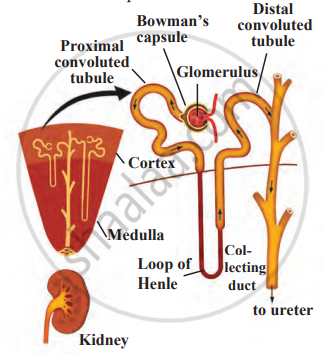
Nephron
Maharashtra State Board: Class 5
Mechanism of Excretion in Humans:
A. Urine Formation
Urine is made in the nephrons (tiny units in the kidneys). The process has three main steps:
- Glomerular Filtration: Waste and extra water are filtered from the blood into the kidney's tubules.
- Tubular Reabsorption: Useful substances like water, glucose, and salts are absorbed back into the blood.
- Secretion: Harmful substances like potassium, hydrogen ions, and ammonia are added to the urine to keep body fluids balanced.
B. Functions of the Tubules
- Glomerulus: Filters the blood.
- Proximal Convoluted Tubules (PCT): Reabsorb water and nutrients, remove toxins, and maintain pH balance.
- Descending Loop of Henle: Lets water out, making the urine more concentrated.
- Ascending Loop of Henle: Allows electrolytes (salts) to move out, diluting the urine.
- Distal Convoluted Tubule (DCT): Reabsorbs water and sodium and helps balance pH.
- Collecting Duct: Reabsorbs lots of water from the urine before it leaves the body.
C. Micturition (Urination)
The urinary bladder fills with urine. Receptors in the bladder send signals to the brain. The brain signals the bladder to release urine through the urethra.
Maharashtra State Board: Class 5
Dialysis:
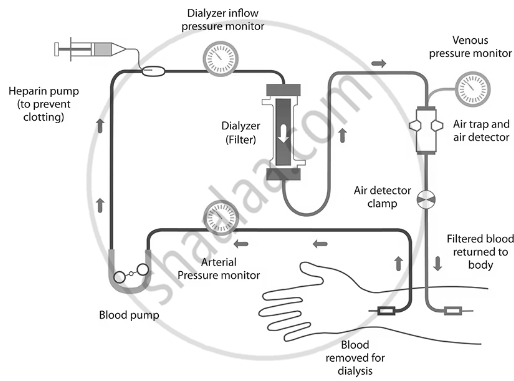
The kidneys may stop working efficiently due to injury, infection, or a decrease in blood supply. When this happens, toxic substances build up in the body, which can be life-threatening. If the kidneys fail, a process called dialysis is used to remove nitrogenous wastes from the blood with the help of a man-made machine. In dialysis:
- About 500 ml of blood is taken out of the body at a time and passed through the machine.
- The machine filters and removes the harmful waste substances. The purified blood is then returned to the patient’s body.
Types of dialysis:
1. Hemodialysis
In haemodialysis, a machine called a dialyzer filters the blood. The blood is removed from the body, cleaned in the machine, and returned to the body. This process is usually done in a hospital or dialysis centre and takes about 3-4 hours, typically a few times a week.
2. Peritoneal Dialysis
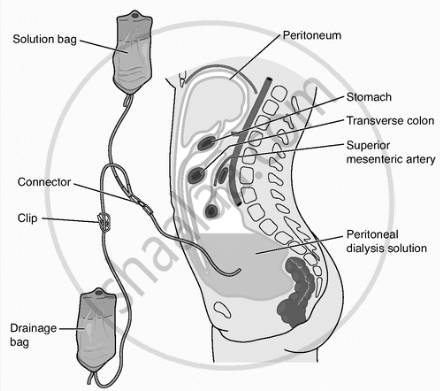
In peritoneal dialysis, the inside lining of your abdomen (called the peritoneum) acts as a natural filter. A special fluid is placed in the abdomen through a tube. This fluid helps draw out waste from the blood. After a few hours, the fluid is drained and replaced with fresh fluid. This type can be done at home, often while sleeping.
CBSE: Class 12
Maharashtra State Board: Class 12
Maharashtra State Board: Class 12
Key Points: Human Excretory System
- The human excretory system consists of a pair of kidneys, two ureters, a urinary bladder and a urethra.
- Kidneys are dark red, bean-shaped, retroperitoneal structures located from the 12th thoracic to the 3rd lumbar vertebra. Size: 10-12 cm × 5-7 cm × 2-3 cm; weight: 150 g (males), 135 g (females).
- Ureters are narrow tubular structures made of transitional epithelium that carry urine from the kidneys to the urinary bladder.
- The urinary bladder is a pear-shaped, hollow, muscular organ in the pelvic cavity, lined by transitional epithelium, and acts as a reservoir of urine.
- Two sphincters exist between the bladder and the urethra: the internal sphincter (involuntary, detrusor muscles) and the external sphincter (voluntary, striated muscles).
- The urethra is a canal-like structure that opens to the exterior via the urethral orifice, much longer in males than in females.
- The aorta supplies oxygenated blood to the kidneys; the inferior vena cava carries deoxygenated blood away from the kidneys.
Video Tutorials
Shaalaa.com | Excretory Products and Elimination part 1 (Introduction)
to track your progress
Series: series 1
0%
Excretory Products and Elimination part 1 (Introduction)
00:10:01 undefined
00:10:01 undefined
Excretion and Osmoregulation Part 1
00:56:50 undefined
00:56:50 undefined
Excretory Products and Elimination part 2 (Nitrogenous Wastes)
00:11:11 undefined
00:11:11 undefined
Excretion and Osmoregulation Part 2
01:36:22 undefined
01:36:22 undefined
Excretory Products and Elimination part 3 (Excretion in animals)
00:14:00 undefined
00:14:00 undefined
Excretory Products and Elimination part 4 (Arthropoda, Mollusca)
00:04:07 undefined
00:04:07 undefined
Excretory Products and Elimination part 5 (Human Excretory System)
00:07:14 undefined
00:07:14 undefined
Excretory Products and Elimination part 6 (Structure of Kidney)
00:13:45 undefined
00:13:45 undefined
Excretory Products and Elimination part 7 (Nephron: Structure, Glomerulus)
00:11:16 undefined
00:11:16 undefined
