Advertisements
Advertisements
प्रश्न
Name the three filtration barriers that solutes must come across as they move from plasma to the lumen of Bowman’s capsule. What components of the blood are usually excluded by these layers?
Advertisements
उत्तर
The three filtration barriers that solutes must come across as they move from plasma to the lumen of Bowman’s capsule are
- Glomerular capillary endothelium
- Basal lamina or basement membrane
- Epithelium of Bowman’s capsule.
- Blood corpuscles and plasma protein are excluded by these layers.
संबंधित प्रश्न
Protein-free fluid is filtered from blood plasma into the Bowman’s capsule.
Henle’s loop plays an important role in concentrating the urine.
Why is excretion necessary? Name the common excretory substance in our body.
Draw and label the diagram.
Human excretory system
Name the following:
Animals which eliminate urea.
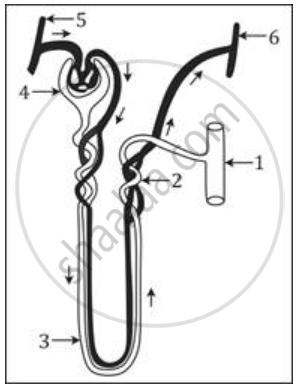
The given diagram represents a nephron and its blood supply. Study the diagram and answer the following question :
Name the two main stages of urine formation.
Write constituents of urine.
What kind of urine (concentration) is produced in the human body?
Give Technical Terms:
What are the organic constituents of normal human urine?
Write the functional activity of the following structure: Urethra
Choose the Odd One Out:
How many kidneys do we have?
Arrange the excretory system in the correct sequence.
(Urinary bladder, Ureter, Kidney, Urethra).
Rearrange the jumbled words and fill in the blanks in the following passage to make it a meaningful description.
The human urinary system consists of a pair of ______ ( nyedik), which form the urine; a pair of ______ (ertreu), which conduct the ______ (neuri) from kidneys to the ______ (naryuri drebdal) for storage of urine and a ______ (reuhrat) through which the urine is voided by bladder contractions.
Match Column I with Column II.
| Column I | Column II |
| A. PCT | (i) Concentrated urine formation |
| B. DCT | (ii) Filtration of blood |
| C. Loop of Henle | (iii) Reabsorption of 70-80% of the electrolyte |
| D. Counter current mechanism | (iv) Ionic balance |
| E. Renal corpuscle | (v) Maintenance of concentration gradient in medulla |
Select the correct option from the codes given below.
The renal cortex has a dotted appearance, and the Renal medulla has a striped appearance. Explain.
Arrange and rewrite the term in the group in the correct order so as to be in a logical sequence, beginning with the term that is underlined.
Lungs, Right auricle, Inferior venacava, Pulmonary Artery.
The process of tubular secretion occurs in ______.
Write full form of the following abbreviation:
PCT
