The diagram given alongside represents an organ system in the human body. Study the same and answer the questions that follow: (a) Identify the system (b) Label the parts marked 2 and 4. Mention the
Advertisements
Question
The diagram given alongside represents an organ system in the human body. Study the same and answer the questions that follow:
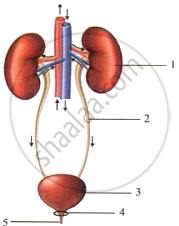
- Identify the system
- Label the parts marked 2 and 4. Mention the function of part 5.
- Name the structural and functional units of the part marked 1.
- What is the fluid that accumulates in part 3?
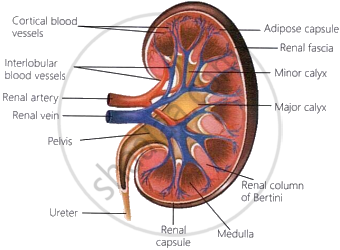
Which is the main nitrogenous waste present in it? - Draw a neat, labelled diagram showing the longitudinal section of part 1.
Advertisements
Solution
- The diagram shows the urinary (excretory) system.
- 2: Ureter
4: Sphincter muscle
Part 5 is the urethra. Its function is to expel urine from the urinary bladder to the outside of the body during urination (micturition). - The structural and functional units of the kidneys are nephrons.
- Fluid that accumulates is urine. The main nitrogenous waste present in it is urea.
RELATED QUESTIONS
Ascending limb of Henle’s loop is ______ to water, whereas the descending limb is ______to it.
One of Harry’s organs is not functioning properly. There is extra fluid build up in his body causing swelling in his ankles and feet.
What should Harry do? Tick the correct answer.
Which of Harry’s organs is not working properly?
Give a simple definition of excretion.
Give Technical Terms:
The pigments produced by the breakdown of haemoglobin in liver.
Choose the Odd One Out:
Choose the correct option.
The snakes living in desert are mainly ______.
Identify the CORRECT statement.
Which among the following is incorrectly matched?
In between the two adjacent renal pyramids, ..A ... is present. Identify A
Explain the role of kidney in hormone secretion.
