The diagram given alongside represents an organ system in the human body. Study the same and answer the questions that follow: (a) Identify the system (b) Label the parts marked 2 and 4. Mention the
Advertisements
प्रश्न
The diagram given alongside represents an organ system in the human body. Study the same and answer the questions that follow:
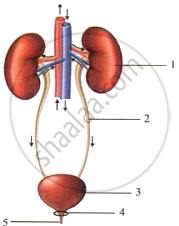
- Identify the system
- Label the parts marked 2 and 4. Mention the function of part 5.
- Name the structural and functional units of the part marked 1.
- What is the fluid that accumulates in part 3?
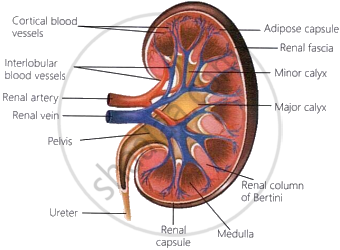
Which is the main nitrogenous waste present in it? - Draw a neat, labelled diagram showing the longitudinal section of part 1.
Advertisements
उत्तर
- The diagram shows the urinary (excretory) system.
- 2: Ureter
4: Sphincter muscle
Part 5 is the urethra. Its function is to expel urine from the urinary bladder to the outside of the body during urination (micturition). - The structural and functional units of the kidneys are nephrons.
- Fluid that accumulates is urine. The main nitrogenous waste present in it is urea.
संबंधित प्रश्न
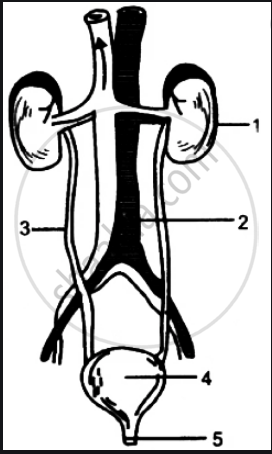
Given below is the figure of certain organs and associated parts in the human body. Study the same and answer the question that follow:
Name the structural and functional unit of the part marked '1'.
Draw a neat and well labeled diagram of human excretory system.
Give Reasons for the following:
Glucose absent in the urine of a healthy person ?
Name the Following
Major excretory organs of man.
Give Technical Term:
The waste product which is excreted by the liver.
The functional unit of kidney is ______.
The human kidneys are located on either side of the vertebral column at the level of ______.
The collecting tubule of the kidney is important as it helps in ______.
What is the contribution of Joseph E. Murray to Nephrology?
Structural unit of kidneys are ______.
