Advertisements
Advertisements
प्रश्न
The diagram given alongside is that of a structure present in a human kidney:
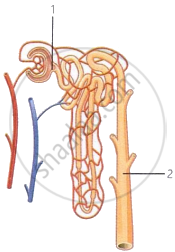
Study the same and answer the questions that follow:
- Name the structure represented in the diagram.
- What is the liquid entering part ‘1’ called?
Name two substances present in this liquid that are reabsorbed in the tubule - What is the fluid that comes to part ‘2’ called? Name the main nitrogenous waste in it.
- Mention the three main steps involved in the formation of the fluid mentioned in (c) above.
- Name the substance which may be present in the fluid in part ‘2’ if a person suffers from Diabetes mellitus
Advertisements
उत्तर
- Nephron
- The liquid entering part 1 is called glomerular filtrate, which is formed by the ultrafiltration of blood through the glomerulus. The two substances present in this liquid are glucose and water.
- The fluid that comes to part 2 is called urine. The main nitrogenous waste in urine is urea.
- The three main steps involved in the formation of urine are:
- Ultrafiltration
- Selective reabsorption
- Tubular secretion
- Glucose
संबंधित प्रश्न
Gums and resins are the ______ products of plants.
Why do some people need to use a dialysis machine? What does the machine do?
Explain the principle of dialysis with the help of a labelled diagram.
Answer the following in short.
List five waste products of plants.
Given below is a set of five terms. Rewrite the terms in their correct order so as to be in logical sequence.
Afferent arteriole, renal vein, secondary capillary network, glomerulus, efferent arteriole.
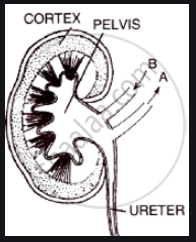
Given below is a highly simplified diagram of the human kidney cut open longitudinally. Answer the question that follow:
Name the functional units of the kidneys.
Choose the correct option.
The part of nephron which absorbs glucose and amino acid is ______.
Answer the following question.
Amphibian tadpole can afford to be ammonotelic. Justify.
The habitat of animals that excrete nitrogenous waste in the form of urea.
When uric acid is produced in excess, it gets deposited in joints, resulting in ____________.
