Advertisements
Advertisements
प्रश्न
The diagram given alongside shows a section of a human kidney. Study the diagram carefully and answer the questions that follow:
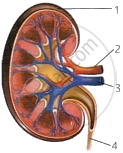
- Label the parts numbered 1 to 4.
- Why does part 2 have a striped appearance?
- What is the fluid that passes down part 4? Name the main nitrogenous waste present in it.
- Mention the structural and functional units of kidneys.
- Name the two major steps in the formation of the fluid mentioned in (c).
Advertisements
उत्तर
- 1: Cortex
2: Medulla
3: Pelvis
4: Ureter - Medulla is composed of a striped substance arranged in several pyramids. Hence, the medulla (b) has a striped appearance.
- Urine passes down part ‘4’, i.e., the ureter. The main nitrogenous substance present in it is urea.
- Nephrons are the structural and functional units of the kidneys.
- The two major steps in the formation of urine are ultrafiltration and selective reabsorption.
APPEARS IN
संबंधित प्रश्न
The form in which glucose in stored in liver.
State the exact location of the Loop of Henle.
Why is it necessary to maintain a normal osmotic concentration of the blood?
What is dialysis? Under what condition is it carried out?
Explain the difference between the excretory system of humans and plants.
Given below is a highly simplified diagram of the human kidney cut open longitudinally. Answer the question that follow:
Name the functional units of the kidneys.
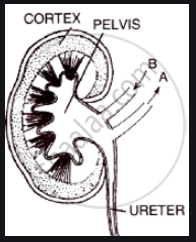
Draw a labeled diagram of the human kidney as seen in a longitudinal section.
Name the Following
The division of the kidney which is light in colour and subdivided into conical renal pyramids.
Write the functional activity of the following structure: Nephron
Elimination of nitrogenous wastes in the form of uric acid takes place in ____________.
