Advertisements
Advertisements
प्रश्न
| Sumit had been observing that his neighbour was going to the hospital every alternate day. After a month, he asked his neighbour (a middle-aged man) whether he was keeping well. The man was touched by the boy's concern and told him that he was going to the hospital as his kidneys are not functioning well. He was undergoing dialysis to remove the impurities from his body. Remembering his chapter on excretion, he understood this major illness. Wishing the man good health, he returned home and started his research on ways/methods doctors around the world try to improve or rectify the working of this organ. He also learnt about kidney (organ) donation. |
- Do some research on this topic and write an article.
- Make a model of dialysis machine.
- Do you know about organ donation? Have you met anyone who has donated his/her kidney?
- In which places in India do we have extensive medical service on kidney transplant?
Advertisements
उत्तर
i.
Life Beyond Failing Kidneys
The kidneys filter waste and excess water from our blood. When they fail, these wastes build up and become poisonous. Doctors then use dialysis, in which the patient's blood is passed through a machine with a semi-permeable membrane. Wastes such as urea pass out into the dialysing fluid and the cleaned blood returns to the body. A patient usually needs this treatment two or three times a week.
Dialysis is only a support, not a cure. The permanent cure is a kidney transplant, in which a healthy kidney from a living relative or from a person who has died is placed in the patient's body. Since a person can live normally with one kidney, a living donor is not harmed.
Scientists are now working on better methods — portable and wearable dialysis machines, artificial kidneys, stem-cell-grown kidney tissue and drugs that reduce organ rejection. But the simplest help still comes from ordinary people: by pledging to donate organs, one person can give life to several others.
ii.
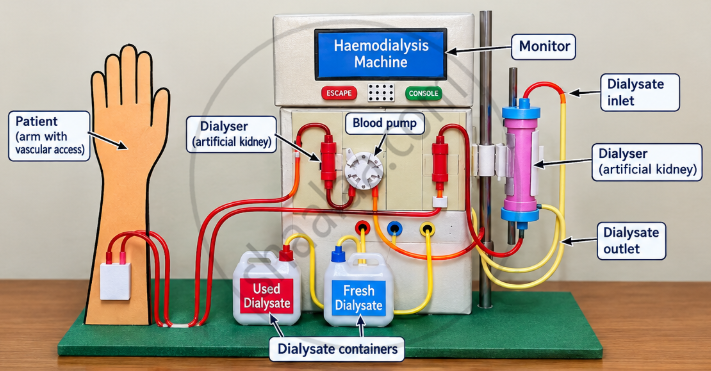
iii. Organ donation is the noble process of legally donating an organ or tissue (like a kidney, liver, or eyes) to a person suffering from organ failure. A healthy living individual can safely donate one kidney, as a single kidney is fully capable of performing all necessary homeostatic filtration functions for a normal lifespan. Organ donation can also be done post-mortem (cadaveric donation) with the family's consent.
Yes, I am aware of organ donation. While I have not personally met a living kidney donor in my immediate circle, I have read inspiring case studies of family members donating a kidney to save their loved ones, allowing them to lead healthy, regular lives post-surgery.
iv. India has several world-class medical institutions and advanced tertiary care facilities across major metropolitan cities specialized in advanced renal care and successful kidney transplants:
- Hyderabad: Home to premier single-specialty centers like the Asian Institute of Nephrology and Urology (AINU).
- Mumbai: Top-tier hospitals providing comprehensive multi-organ transplant care, including Sir H. N. Reliance Foundation Hospital and Fortis Hospital Mulund.
- Delhi NCR: Renowned national medical centers like the All India Institute of Medical Sciences (AIIMS) and Medanta - The Medicity (Gurugram).
- Vellore: The historic Christian Medical College (CMC), a pioneer in renal transplantation in India.
- Chennai and Bengaluru: Major hubs with specialized networks like Apollo Hospitals and Manipal Hospitals.
