Advertisements
Online Mock Tests
Chapters
1: Cell Division
2: Structure of Chromosomes
3: Principles of Genetics
Unit-2 Plant Physiology
4: Absorption by Roots
5: Transpiration
▶ 6: Photosynthesis
7: Chemical Coordination in Plants
8: Circulatory System
Unit-3 Human Anatomy and Physiology
9: Excretory System
10: Nervous System
11: Endocrine System
12: Reproductive System
13: Human Population
14: The Evolution of Man
15: Theories of Evolution
16: Types of Pollution
17: Sources of Pollution and Major Pollutants
18: Effects of Pollution
19: Abatement of Pollution
20: Greenhouse Effects, Global Warming, Ozone Layer Depletion and Acid Rain
![Frank solutions for Biology Part 2 [English] Class 10 ICSE chapter 6 - Photosynthesis - Shaalaa.com](/images/biology-part-2-english-class-10-icse_6:4cd9978ddb1c4f42b0b0e9ec6f09c057.jpg "Frank solutions for Biology Part 2 [English] Class 10 ICSE chapter 6 - Photosynthesis")
Advertisements
Solutions for Chapter 6: Photosynthesis
Below listed, you can find solutions for Chapter 6 of CISCE Frank for Biology Part 2 [English] Class 10 ICSE.
Frank solutions for Biology Part 2 [English] Class 10 ICSE 6 Photosynthesis Exercises [Pages 82 - 90]
Choose the correct answer:
Which one of the following is the best reason for leaving a plant in a dark place before carrying out experiments on photosynthesis?
To remove chlorophyll from the leaves.
To increase the release of CO2 by the leaves.
To remove starch from the leaves.
To stop synthesis process in the leaves.
Choose the correct answer:
Which one of the following features of plant leaves plays an important part in photosynthesis?
Thick cuticle
Spongy mesophyll
Chloroplasts
Stomata
The specific function of light energy in the process of photosynthesis is to
reduce carbon dioxide
synthesise glucose
activate chlorophyll
split water molecule
Choose the correct answer:
In a typical leaf, photosynthesis occurs mainly in ___________
Cuticle
epidermis
Palisade mesophyll
spongy Mesophyll
Choose the correct answer:
Energy is transformed from the light reaction to the dark reaction by _______________
Chlorophyll
ADP
ATP
RuDP
Choose the correct answer:
A cell that lacks chloroplast does not ______________
Evolve CO2
liberate O2
Require water
utilize carbohydrates
Choose the correct answer:
Light reaction takes place in ____________
Grana
stroma
Chloroplast membrane
endoplasmic reticulum
Choose the correct answer:
Photosynthesis is more active in ___________
green light
red light
Yellow light
violet light
Choose the correct answer:
Which of the following gas is used in photosynthesis?
Oxygen
Hydrogen
Nitrogen
Carbon dioxide
Choose the correct answer:
The process of photosynthesis occurs by _________
carbon dioxide and water
carbon dioxide, chlorophyll and water
water, chlorophyll, sunlight
water, carbon dioxide, chlorophyll and sunlight
The individual flattened stacks of membranous structures inside the chloroplasts are known as ______.
grana
stroma
thylakoids
cristae
The site of light reaction in the cells of a green leaf is ______.
Nucleus
Grana of chloroplast
Cytoplasm
Strama of chloroplast
The process of conversion of ADP to ATP during photosynthesis is called ______.
Photolysis
Phagocytosis
Photophosphorylation
Polymerisation
Assertion-Reason Type Questions Following questions consist of two statements - Assertion (A) and Reason (R). Answer these questions by selecting the appropriate option given below:
Assertion (A): Photosynthesis is an endothermic process.
Reason (R): It requires light energy to convert carbon dioxide and water into glucose.
Both A and R are true and R is the correct explanation of A.
Both A and R are true but R is not the correct explanation of A.
A is true but R is false.
A is false but R is true.
Assertion (A): The Calvin cycle is a part of the light-dependent reactions in photosynthesis.
Reason (R): The Calvin cycle is responsible for the synthesis of ATP and NADPH.
Both A and R are true and R is the correct explanation of A.
Both A and R are true but R is not the correct explanation of A.
A is true but R is false.
A is false but R is true.
Assertion (A): Photosynthesis occurs in both plants and animals.
Reason (R): Some algae and bacteria can perform photosynthesis.
Both A and R are true and R is the correct explanation of A.
Both A and R are true but R is not the correct explanation of A.
A is true but R is false.
A is false but R is true.
Assertion (A): Light-independent reactions occur in the thylakoid membrane.
Reason (R): Thylakoid membranes contain pigments that capture light energy.
Both A and R are true and R is the correct explanation of A.
Both A and R are true but R is not the correct explanation of A.
A is true but R is false.
A is false but R is true.
Assertion (A): The primary pigment involved in photosynthesis is chlorophyll a.
Reason (R): Chlorophyll a absorbs light most effectively in the red and blue regions of the electromagnetic spectrum.
Both A and R are true and R is the correct explanation of A.
Both A and R are true but R is not the correct explanation of A.
A is true but R is false.
A is false but R is true.
Assertion (A): Photosynthesis is an anabolic process.
Reason (R): It involves the synthesis of complex organic molecules from simpler substances.
Both A and R are true and R is the correct explanation of A.
Both A and R are true but R is not the correct explanation of A.
A is true but R is false.
A is false but R is true.
Assertion (A): Photosynthesis is the reverse process of cellular respiration.
Reason (R): Cellular respiration releases carbon dioxide and water, while photosynthesis uses them to produce glucose.
Both A and R are true and R is the correct explanation of A.
Both A and R are true but R is not the correct explanation of A.
A is true but R is false.
A is false but R is true.
Assertion (A): Photosynthesis occurs in the stroma of the chloroplast.
Reason (R): The stroma is the site of the Calvin cycle, where glucose is synthesised.
Both A and R are true and R is the correct explanation of A.
Both A and R are true but R is not the correct explanation of A.
A is true but R is false.
A is false but R is true.
Assertion (A): Photosystem II comes before Photosystem I in the light-dependent reactions.
Reason (R): Photosystem II absorbs light at a shorter wavelength than Photosystem I.
Both A and R are true and R is the correct explanation of A.
Both A and R are true but R is not the correct explanation of A.
A is true but R is false.
A is false but R is true.
Assertion (A): Photosynthesis occurs in the presence of oxygen.
Reason (R): Oxygen is a necessary reactant for the synthesis of glucose.
Both A and R are true and R is the correct explanation of A.
Both A and R are true but R is not the correct explanation of A.
A is true but R is false.
A is false but R is true.
Assertion (A): The oxygen released during photosynthesis comes from the carbon dioxide molecule.
Reason (R): Oxygen is a byproduct of the reduction of carbon dioxide during photosynthesis.
Both A and R are true and R is the correct explanation of A.
Both A and R are true but R is not the correct explanation of A.
A is true but R is false.
A is false but R is true.
Assertion (A): Photosynthesis is more efficient in red and blue light compared to green light.
Reason (R): Chlorophyll absorbs red and blue light most effectively.
Both A and R are true and R is the correct explanation of A.
Both A and R are true but R is not the correct explanation of A.
A is true but R is false.
A is false but R is true.
Assertion (A): Photosynthesis produces glucose, which is used as a source of energy.
Reason (R): Glucose is broken down in the mitochondria during cellular respiration to release energy.
Both A and R are true and R is the correct explanation of A.
Both A and R are true but R is not the correct explanation of A.
A is true but R is false.
A is false but R is true.
Name the following:
The principal site in a green leaf for photosynthesis.
Name the following:
The products that are formed as a result of photosynthesis.
Name the following:
Three organisms that cannot prepare their own food by photosynthesis.
Name the following:
The main reaction by which the molecule of water is broken down by means of light.
Name the following:
The main mineral constituent of chlorophyll.
Name the following:
The cell organelle responsible for photosynthesis.
Name the following:
The part of the chloroplasts where the light reaction of photosynthesis takes place.
Name the following:
The process of conversion of ADP into ATP during photosynthesis.
Name the following:
The process of transformation of several glucose molecules into one molecule of starch.
______ is the process in plants which replenishes the atmospheric oxygen.
Fill in the blank:
Land plants obtain their carbon dioxide from the ______.
Fill in the blank:
Photosynthesis produces oxygen and ______.
Fill in the blank:
Xanthophyll is ______ coloured pigment.
Fill in the blanks:
The end products of photosynthesis are ______ and ______.
Fill in the blank:
CO2 enters the leaf through ______.
The following statement is about photosynthesis in a green plant. Write whether it is True or False.
The raw materials for photosynthesis include water and carbon dioxide.
True
False
The following statement is about photosynthesis in a green plant. Write whether it is True or False.
Land plants obtain their carbon dioxide from the atmosphere.
True
False
The following statement is about photosynthesis in a green plant. Write whether it is True or False.
Photosynthesis occurs in underground organs as well as in aerial ones.
True
False
The following statement is about photosynthesis in a green plant. Write whether it is True or False.
Photosynthesis results in a gain in dry weight.
True
False
The following statement is about photosynthesis in a green plant. Write whether it is True or False.
A variegated leaf (one that has white as well as green patches) will only photosynthesize in the green areas.
True
False
The following statement is about photosynthesis in a green plant. Write whether it is True or False.
The source of energy is light.
True
False
The following statement is about photosynthesis in a green plant. Write whether it is True or False.
Green light is more effective than any other colour.
True
False
The following statement is about photosynthesis in a green plant. Write whether it is True or False.
The growing tips of stems and roots will be photosynthesizing actively compared with the rest of the plant.
True
False
The following statement is about photosynthesis in a green plant. Write whether it is True or False.
Photosynthesis produces oxygen.
True
False
The following statement is about photosynthesis in a green plant. Write whether it is True or False.
Photosynthesis occurs in all the cells of the plant.
The following statement is about photosynthesis in a green plant. Write whether it is True or False.
Photosynthesis stops at a temperature above 35°C.
Match the terms of column I with those in column II:
| Column I | Column II |
| (i) Stomata closed | (a) decomposers |
| (ii) Autotrophs | (b) light reaction |
| (iii) By-products of photosynthesis | (c) animals |
| (iv) Photolysis | (d) during night |
| (v) Bacteria and fungi | (e) green plants |
| ( f) oxygen |
Complete the following by filling in the blanks numbered 1 to 10 with the appropriate word/term:
Photosynthesis involves light reaction and dark reaction. During light reaction, the chlorophyll present in the (1) ______ gets activated by absorbing light energy. This energy splits (2) ______ molecules to (3) ______ and oxygen and releases two electrons. This process is called (4) ______. The (5) ______ ions are picked up by NADP to form (6) ______. The ADP is converted to (7) ______. This process is called (8) ______. During the dark phase, the compound produced at the end of the light reaction reacts with carbon dioxide to form (9) ______. This product is converted to starch. The process is called (10) ______.
Answer the following:
Give the overall chemical equation of photosynthesis in green plants.
Answer the following:
Mention two significant advantages of photosynthesis to the living world as a whole.
Define the following:
Plant pigments
Define the following:
Organic food
Define the following:
Light reaction
Define the following:
Photolysis in photosynthesis
Complete the following statement by choosing the correct alternative given below :
All animals would die on the earth if there was no ______.
chlorophyll
haemoglobin
penicillin
Given below is the overall chemical equation of photosynthesis which is incomplete in certain respects.
\[\ce{CO2 + H2O ->[Chlorophyll] C6H12O6 + H2O + O2} \]
Rewrite the equation in its complete form .
Distinguish between the following:
Hill reaction and NADP reduction in chloroplast.
Distinguish between the following:
Photosynthesis and photophosphorylation.
Differentiate Between:
Chloroplast and Chlorophyll
Define dark reaction.
Give an overall balanced equation of the dark reaction process.
Describe an experiment to prove that sunlight is necessary for photosynthesis.
Mention any two points in which photosynthesis and respiration in plants are opposite to each other.
What is meant by photosynthesis? Why is it so important in nature?
Describe fully one experiment with potted green plant to show that starch is not produced in the leaves when carbon dioxide is not available (diagrams essential)
A healthy oat seeding in a pot is transferred from light to any airy but completely dark room. How would it differ from its original condition in appearance after about a week? Explain the difference.
Mention two ways in which photosynthesis is useful to life.
Explain why respiration is said to be a reversal of photosynthesis.
What is the role of chlorophyll in green plant?
(i) Fill in the blanks in the following equations of two chemical reactions:
(a) \[\ce{---+12H2O->[Light energy]C6H12O6 + --- + ----}\]
(b) \[\ce{--- 6O2->[Chlorophyll] 6 --- +6 ---- + Energy}\]
(ii) Name the two processes represented by the above two reactions.
(iii) State any two differences in these processes other than those already indicated in the reactions.
(iv) Which one of these two reactions is the supporter of all life on earth?
A potted destarched plant was taken in order to prove that light is necessary for photosynthesis.
(i) What is meant by 'destarched plant'? How can it be destarched?
(ii) Using the destarched plant describe step by step how you would proceed to prove that in the absence of light the leaf cannot manufacture starch.
An experiment was set up as shown in the figure given below . The twig in the diagram was intact on the plant and it was as such in sunlight for a few hours .
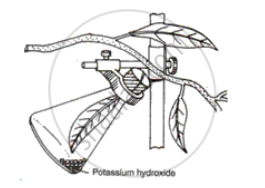
(i) What is the aim of the above experiment ?
(ii) Why was potassium hydroxide placed inside the conical flask ?
(iii) What test would you perform on the leaf inside the flask?
(iv) What is the expected result of the above test ?
(v) Is it necessary to similarly test on outer leaf also ? Giva a reason .
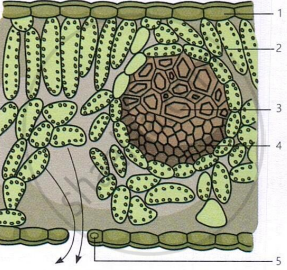
Fig. represents the vertical section of a leaf.
- Name the parts labelled 1 to 5.
- What do the two arrows (dotted and solid) indicate in the daytime and at night?
- Could you add one more arrow in the figure? If yes, what for?
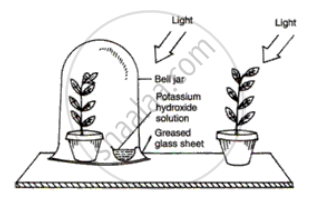
Two healthy green plants were placed in the dark for 24 hours. They were then set up, as shown in the figure, for 4 hours. Then a leaf was taken from each plant and
the chlorophyll was removed from the leaves:
( i) What is the next and final step in this experiment?
( ii ) What would be the results of the final step?
( iii ) Why was it necessary to grease the glass sheet?
( iv ) What hypothesis is being tested in this experiment?
How does carbon dioxide return to the atmosphere? Explain.
A student in order to study the importance of certain factors of photosynthesis took a potted plant and kept it in the dark for over 24 hours. Then in the early hours of the morning the student covered one of the leaves with black paper in the centre only. Student placed the potted plant in the sunlight for a few hours, and then tested the leaf which was covered with black paper for starch.
(i) What aspect of photosynthesis was being investigated?
(ii) Is there any control in this experiment? If so, state the name.
(iii) Why was the plant kept in the dark before the experiment?
(iv) Describe step by step how the candidate proceeded to test the leaf for the presence of starch.
The diagram is set up to demonstrate an experiment. Pond weed was placed in five water-filled tubes. The experiment was set up as shown in the diagram. The tubes were then left for 24 hours. Write the correct answer out of the five available choices:
(i) In which tube would you except to find the plant with the least amount of starch?
(a ) 1 (b) 2 (c) 3 (d) 4 (e ) 5
(ii) The tube in which most oxygen would be found is
(a ) 1 (b) 2 (c) 3 (d) 4 (e ) 5
(iii) The tube in which least carbon dioxide would be found is
(a ) 1 (b) 2 (c) 3 (d) 4 (e ) 5
(iv) The tube in which the plant would survive for the shortest length of time is
(a ) 1 (b) 2 (c) 3 (d) 4 (e) 5

The diagram alongside refers to an experiment in which the apparatus was set up with the light source 10 cm away from the plant. After 15 minutes the number of bubbles evolved per minute from the cut stem was recorded. The light source was moved to 20 cm away from the plant, left for 15 minutes and the number of bubbles evolved per minute was again recorded. The experiment was repeated with the light source at distances of 40, 60, 80 and 100 cm away from the plant. Plot a graph for the results obtained and answer the following questions.
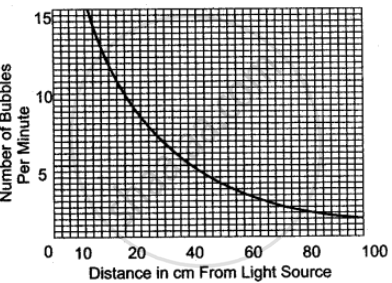
(i) From the graph it seems likely that the rate of bubbling per minute at 50 cm would have been
(a) 2.0 (b) 2.5 (c) 3.0 (d) 3.5
(ii) The gas produced by the plant during the experiment was
(a) air (b) oxygen (c) carbon dioxide (d) nitrogen (e) hydrogen
(iii) The gas collected comes due to the breakdown of
(a) glucose (b) starch (c) water (d) air (e) ATP
(iv) If ice cubes were added to the water, the rate of bubble formation would
(a) Stay the same.
(b) Increase because more water is added.
(c) Decrease because the temperature drops.
(d) Decrease because water freezes.
(e) Cannot tell from the information given.
(v) If some sodium bicarbonate is added to the water the rate of bubble formation
(a) Increases because more respiration occurs.
(b) Increases because more photosynthesis occurs.
(c) Increases because the gas becomes less soluble.
(d) Decreases because carbon dioxide acts as a limiting factor.
(e) Decreases because respiration decreases.
The diagram alongside represents an experiment conducted to prove the importance of a factor in photosynthesis.
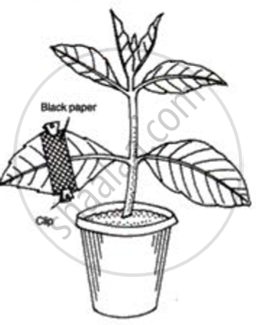
Study the same and then answer the questions that follow:
(i) Name the factor being studied in his experiment.
(ii) Why was the plant kept in a dark room before conducting the experiment?
(iii}Why was the experimental leaf then kept in
1. boiling water 2. methylated spirit?
(iv) Name the solution used to test for the presence of starch in the leaf.
(v) What will we observe in the experimental leaf at the end of the starch test?
(vi) Give a balanced chemical equation to represent the process of photosynthesis.
Fig. shows an experiment conducted to study a factor necessary for photosynthesis. Observe the diagram and then answer the following questions.
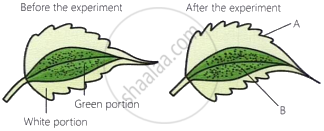
- What is the aim of the experiment?
- Name the test performed on the leaf and the solution used for the test.
- What type of leaf was used for the experiment? Give an example.
- What is the expected result of the above test on the parts labelled A and B.
A potted plant was taken in order to prove a factor necessary for photosynthesis. The potted plant was kept in the dark for 24 hours. One of the leaves was covered with black paper in the centre.The potted plant was then placed in sunlight for a few hours.
- What aspect of photosynthesis was being tested?
- Why was the plant placed in the dark before beginning the experiment?
- During the starch test why was the leaf
- boiled in water
- boiled in methylated spirit
- Write a balanced chemical equation to represent the process of photosynthesis.
- Draw a neat diagram of a chloroplast and label its parts.
The diagram below shows two test-tubes A and B. Test-tube A contains a green water plant. Test-tube B contains both a green water plant and a snail. Both test-tubes are kept in sunlight. Answer the questions that follow:

(a) Name the physiological process that releases the bubbles of oxygen.
(b) Explain the physiological process as mentioned above in (a).
(c) What is the purpose of keeping a snail in test-tube B?
(d) Why does test-tube B have more bubbles of oxygen?
(e) Give an example of a water plant that can be used in the above experiment.
(f) Write the overall chemical equation for the above process.
Fig. demonstrates a physiological process taking place in green plants. The whole set-up was placed in bright sunlight for several hours. Study the diagram and answer the questions that follow:
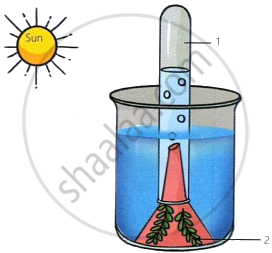
- What aspect of the physiological process is being examined?
- Explain the physiological process mentioned in (a) above.
- Label the parts numbered 1 and 2 in the diagram.
- Write a well-balanced chemical equation for the physiological process explained in (b) above.
- What would happen to the rate of bubbling of the gas if a pinch of sodium bicarbonate is added to the water in the beaker? Explain your answer.
Complete the following by filling the blanks 1 to 5 with appropriate words/terms/phrases:
To test the leaf for starch, the leaf is boiled in water to ______ (1). It is next boiled in methylated spirit to ______ (2). The leaf is placed in warm water to soften it. It is then placed in a dish and ______ (3) solution is added. The region which contains starch, turns ______ (4) and the region which does not contain starch, turns ______ (5)
A potted plant with variegated leaves was taken in order to prove a factor necessary for photosynthesis. The potted plant was kept in the dark for 24 hours and then placed in bright sunlight for a few hours. Observe the diagrams and answer the questions:

- What aspect of photosynthesis is being tested in the above diagram?
- Represent the process of photosynthesis in the form of a balanced equation.
- Why was the plant kept in the dark before beginning the experiment?
- What will be the result of the starch test performed on Leaf ‘A’ shown in the diagram? Give an example of a plant with variegated leaves
- Draw a neat labelled diagram of a chloroplast.
Study the diagram given below and fill in the blanks with suitable words:
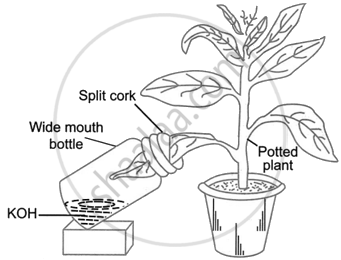
In order to prove that carbon dioxide is necessary for
(a) ______, a potted plant is placed in dark for 48 hours to (b) ______ the leaves. A part of a leaf is inserted into a conical flask containing potassium hydroxide solution. This is to absorb (c) ______ from the flask. The plant is then placed in sunlight for a few hours. The experimental leaf is tested for starch. The part of the leaf that was inside the conical flask turns (d) ______, whereas the part of the left outside turns (e) ______ in colour.
The diagram given below represents an experiment to prove the importance of a factor in photosynthesis. Answer the questions that follow:
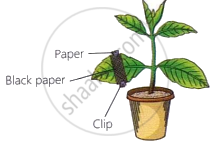
- Name the factor studied in this experiment.
- What will you observe in the experimental leaf after the starch test?
- Explain the process of photosynthesis.
- Give a balanced chemical equation to represent the process of photosynthesis.
- Draw a neat, labelled diagram of an experimental setup to show that oxygen is released during photosynthesis.
The diagram given below represents an experiment to prove the importance of a factor in photosynthesis. Answer the questions that follow:
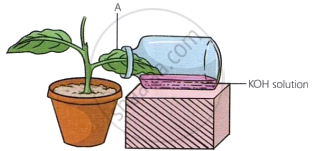
- Which factor is being studied here?
- What is the purpose of keeping KOH in the flask?
- Explain the term photosynthesis.
- What will you observe when the leaf A is tested for starch?
- Write a well balanced chemical equation for the process of photosynthesis.
A potted plant with variegated leafes was kept in dark for 24 hours and then placed in bright sunlight. Answer the following questions.
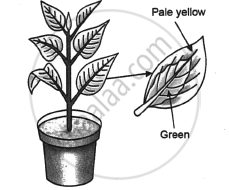
- Which aspect of photosynthesis is being tested in the above diagram?
- Why was the plant kept in the dark for 24 hours?
- After the starch test, what will be the colour of the yellow and green parts of the leaf? Give reasons to support your answer.
Draw a neat, labelled diagram of a chloroplast.
Expand the abbreviation - NADP.
Explain the term ‘Photolysis’.
Solutions for 6: Photosynthesis
Frank solutions for Biology Part 2 [English] Class 10 ICSE chapter 6 - Photosynthesis
Shaalaa.com has the CISCE Mathematics Biology Part 2 [English] Class 10 ICSE CISCE solutions in a manner that help students grasp basic concepts better and faster. The detailed, step-by-step solutions will help you understand the concepts better and clarify any confusion. Frank solutions for Mathematics Biology Part 2 [English] Class 10 ICSE CISCE 6 (Photosynthesis) include all questions with answers and detailed explanations. This will clear students' doubts about questions and improve their application skills while preparing for board exams.
Further, we at Shaalaa.com provide such solutions so students can prepare for written exams. Frank textbook solutions can be a core help for self-study and provide excellent self-help guidance for students.
Concepts covered in Biology Part 2 [English] Class 10 ICSE chapter 6 Photosynthesis are Carbon Cycle, Regulation of Stomatal Opening for Carbon Dioxide Intake, Experiments on Photosynthesis, Adaptations in Leaves to Perform Photosynthesis, Process of Photosynthesis, Factors Affecting Photosynthesis, Products of Photosynthesis, Opening and Closing of Stomata, Light Reaction, Light-Independent Phase of Photosynthesis, Significance of Photosynthesis, Concept of Photosynthesis, Chlorophyll: The Vital Plant Pigment, Carbon Cycle, Regulation of Stomatal Opening for Carbon Dioxide Intake, Experiments on Photosynthesis, Adaptations in Leaves to Perform Photosynthesis, Process of Photosynthesis, Factors Affecting Photosynthesis, Products of Photosynthesis, Opening and Closing of Stomata, Light Reaction, Light-Independent Phase of Photosynthesis, Significance of Photosynthesis, Concept of Photosynthesis, Chlorophyll: The Vital Plant Pigment.
Using Frank Biology Part 2 [English] Class 10 ICSE solutions Photosynthesis exercise by students is an easy way to prepare for the exams, as they involve solutions arranged chapter-wise and also page-wise. The questions involved in Frank Solutions are essential questions that can be asked in the final exam. Maximum CISCE Biology Part 2 [English] Class 10 ICSE students prefer Frank Textbook Solutions to score more in exams.
Get the free view of Chapter 6, Photosynthesis Biology Part 2 [English] Class 10 ICSE additional questions for Mathematics Biology Part 2 [English] Class 10 ICSE CISCE, and you can use Shaalaa.com to keep it handy for your exam preparation.
